Economics Department Information

Major requirements, department links, transfer-credit rules, faculty research, and career information for University of Rochester economics students.

← Back to Office Hours & Student Information

Featured · Rochester economics outcomes

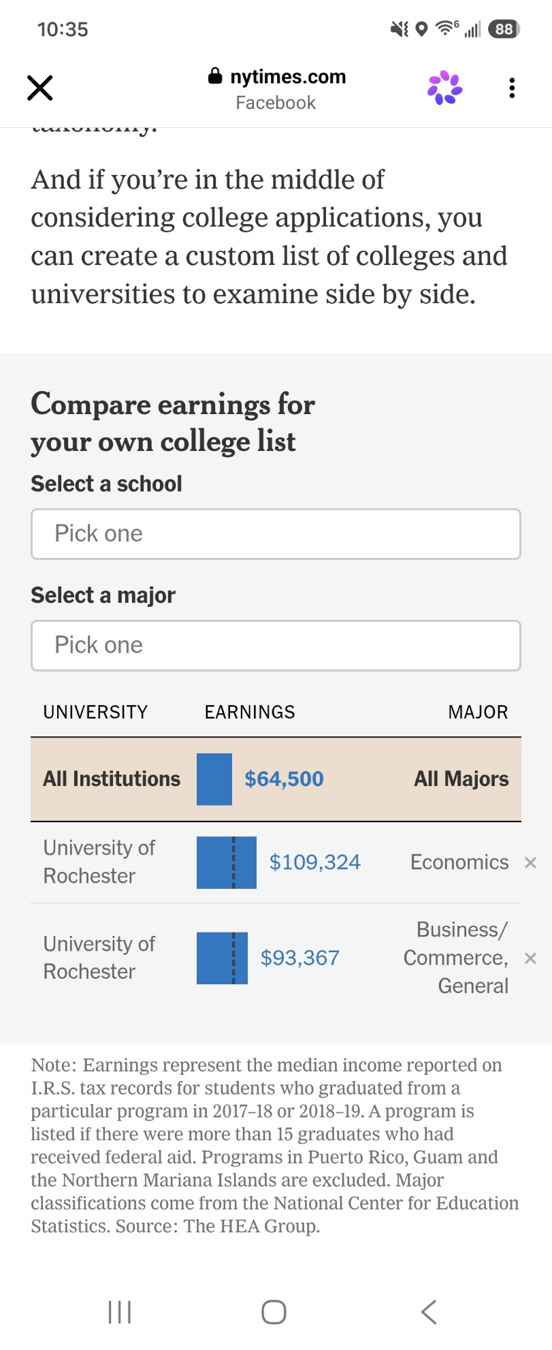
What do Rochester economics graduates earn?

$109,324

Median earnings for University of Rochester economics graduates in the comparison shown.

Considering an economics major? Put this on your radar. The New York Times comparison shown here reports Rochester economics graduates earning $15,957 more — about 17% higher — than Rochester graduates in Business/Commerce, General.

Median earnings shown in the comparison
School / majorEarnings
University of Rochester · Economics$109,324
University of Rochester · Business/Commerce, General$93,367
All Institutions · All Majors$64,500

Source and scope: The supplied New York Times screenshot credits The HEA Group. Its note describes median income from IRS tax records for graduates of 2017–18 or 2018–19 programs, with programs listed when more than 15 graduates received federal aid. These are reported graduate outcomes, not starting-salary guarantees; the comparison alone does not establish how much of the gap the major itself causes.

Explore Rochester’s economics majors · Discuss what explains the earnings gap →

New York Times college earnings comparison: University of Rochester Economics, $109,324; Rochester Business/Commerce, General, $93,367; All Institutions and All Majors, $64,500. Source note credits The HEA Group.
Original screenshot, including the source note. Select the image to view it at full size.

Use the official department pages as the source of truth

This page is a readable student guide. Degree rules, transfer-credit rules, advising assignments, course lists, and approval processes can change. Always verify details on the official Economics Department website before making registration or graduation decisions.

New Economics Majors

Readable summary of the new BA/BS structure and the BS in Financial Economics. Verify details with the official department page.

BA in Economics

FlexibleApplied electives

Core

  • ECON 108
  • ECON 207
  • ECON 209
  • ECON 232: Data Science for Economics

Electives

  • Five economics electives at the 200-level or above.
  • Three open electives.
  • Two from a curated applied list such as behavioral, labor, education, public, development, globalization, trade, international macro, Freakonomics, or senior seminar.

Allied Field and Math

  • Two allied-field courses under the existing BA-style rules.
  • First class in the calculus sequence: AP Calc, MTH 141, MTH 161, or MTH 171.
See BA required courses and elective menu

BS in Economics

More quantitativeAdvanced electives

Core

  • ECON 108
  • ECON 207
  • ECON 209
  • ECON 230 or equivalent: MTH 203 or STT 190
  • ECON 231W

Electives

  • Five economics electives at the 200-level or above.
  • Three open electives.
  • Two from a curated advanced list such as Advanced Micro, Advanced Macro, Game Theory, Fair Allocation, Trade, International Macro, Behavioral, Financial Econometrics, or Senior Seminar.

Allied Field and Math

  • Two allied-field courses.
  • Complete calculus sequence: MATH 141, 142, and 143 (or MATH 161–162 or MATH 171–172).
See BS required courses and elective menu

BS in Financial Economics

Finance + economicsSTEM-style training

Economics Core

  • ECON 108, 207, 209
  • ECON 230 or approved statistics pathway
  • ECON 231W

Financial Economics Core

  • FIN 205
  • FIN 206
  • ACC 201
  • ECON 211: Money, Credit, and Modern Financial Institutions

Electives and Allied Fields

  • Three economics electives, one from the designated Financial Economics economics-elective list.
  • One of the economics electives must be taken for W credit.
  • Two allied-field electives from the designated pool; they do not need to be from the same field.
  • Complete calculus sequence: MATH 141–142, MATH 161–162, or MATH 171–172.
See Financial Economics required courses and elective menu

Notes on transition rules

Calculus classes are pre-major requirements and are not subject to overlap requirements. Statistics classes will be subject to standard overlap rules. ECON 230 is the standard statistics path, but there are additional approved pathways in some cases, including AP Statistics credit plus STAT 181, the Statistics Program bridging module; the STAT 181/182 pathway where applicable; and, for some Political Science double majors, the PSCI 200 Data Analysis I plus PSCI 205 Data Analysis II sequence. In special cases, ECON 232 may substitute for ECON 230. Class of 2027, 2028 and 2029 students who have already declared the BA in Econ or Financial Economics may continue in those degree paths. All Class of 2030 students and current undeclared underclassmen will choose from our three new major offerings.

Switching from an existing economics major?

If you are already declared in an economics major and want to move into one of the new majors, please first use the College’s change form to drop your existing major.

After talking the new program over with Professor Rizzo, use the regular major declaration form to declare the new program.

Required Courses and Elective Menus

Use this section to see the full course options listed in the BA, BS, and Financial Economics proposal documents. Open electives mean eligible ECON courses at the 200-level or above, subject to ordinary department rules and final approval.

Important: These are student-facing planning lists built from the proposal documents, not the official registrar. Course numbers, titles, and final elective pools should be checked against the official department website before a student makes a graduation plan.

Statistics note: ECON 230 remains the ordinary path for satisfying the economics statistics requirement. Additional pathways may be approved in particular cases, including AP Statistics credit plus STAT 181, the Statistics Program bridging module; the STAT 181/182 pathway where applicable; and, for some Political Science double majors, PSCI 200 Data Analysis I plus PSCI 205 Data Analysis II. Students should verify approval before assuming a substitute satisfies the major.

BA in Economics

Applied and flexible11 major courses

Pre-major math

  • MATH 141
  • MATH 161
  • MATH 171

Economics core

  • ECON 108 — Principles of Economics
  • ECON 207 — Intermediate Microeconomics
  • ECON 209 — Intermediate Macroeconomics
  • ECON 232 / Data Methods in Economics — listed as ECON XXX in the proposal

Open economics electives

  • Three ECON electives at the 200-level or above.

Applied economics elective pool: choose two

  • ECON 271 — Behavioral Economics
  • ECON 225 — Freakonomics
  • ECON 275 — Development Economics
  • ECON 223 — Labor Economics
  • ECON 237 — Economics of Education
  • ECON 263 — Public Economics
  • ECON 270 — International Macro
  • ECON 269 — International Trade
  • ECON 389 — Senior Seminar

Allied field

  • Two allied-field courses under the existing BA-style allied-field rules.

BS in Economics

Quantitative and methodological12 major courses

Pre-major calculus sequence

  • MATH 141, 142, and 143 (or MATH 161–162 or MATH 171–172)

Economics core

  • ECON 108 — Principles of Economics
  • ECON 207 — Intermediate Microeconomics
  • ECON 209 — Intermediate Macroeconomics
  • ECON 230 — Economic Statistics, or equivalent such as STAT 213 / other approved equivalent
  • ECON 231W — Econometrics

Open economics electives

  • Three ECON electives at the 200-level.

Advanced / formal-methods elective pool: choose two

  • ECON 218 — Topics in Microeconomics / Advanced Microeconomics
  • ECON 219 — Advanced Macroeconomics
  • ECON 233 — Financial Econometrics
  • ECON XXX / ECON 232 — Data Science / Data Methods for Economics
  • ECON 288 — Game Theory
  • ECON 389 — Senior Seminar

Allied field

  • Two allied-field courses.

BS in Financial Economics

Finance, institutions, and economics14 major courses

Pre-major calculus sequence

  • MATH 141–142, MATH 161–162, or MATH 171–172

Economics core

  • ECON 108 — Principles of Economics
  • ECON 207 — Intermediate Microeconomics
  • ECON 209 — Intermediate Macroeconomics
  • ECON 230 — Economic Statistics, or approved statistics pathway
  • ECON 231W — Econometrics

Finance-accounting core

  • FIN 205 — Managerial Finance
  • FIN 206 — Investments
  • ACC 201 — Accounting
  • ECON 211 — Money, Banking, and Credit / Modern Financial Institutions

Economics electives

  • Three economics electives.
  • One of the three must come from the designated Financial Economics economics-elective list below.
  • One of the economics electives must be taken for W credit.

Financial Economics economics-elective list: choose one

  • ECON 219 — Advanced Macroeconomics
  • ECON 223 — Labor Economics
  • ECON 233W — Financial Econometrics
  • ECON 263 — Public Finance
  • ECON 268 — Globalization
  • ECON 269 — International Trade
  • ECON 270 — International Macroeconomics
  • ECON 275 — Developmental Economics
  • ECON 277 — Financial Crises

Allied-field electives: choose two

The two allied-field electives are not required to be from the same field.

Finance and accounting

  • ACC 221 — Managerial Accounting
  • ACC 222 — Financial Statements
  • FIN 213 — Corporate Finance
  • FIN 224 — Options, Futures, and Derivatives
  • FIN 242 — International Finance
  • FIN 246 — Cryptocurrencies, Blockchain, and FinTech

Data and computer science, information systems

  • CSC 161 — Intro Programming (Python)
  • CSC 171 — Introduction to Computer Science
  • CSC 242 — Artificial Intelligence
  • CSC 246 — Machine Learning
  • DSCC 201 — Tools for Data Science
  • CSC/DSCC 240 — Data Mining
  • CSC/DSCC 261 — Database Systems
  • CIS 191 — Python and Analytics
  • CIS 211 — Modeling with Excel
  • CIS 220 — Business Information Systems
  • CIS 240 — Database Management
  • CIS 242 — Predictive Analytics
  • CIS 279 — AI and Business Applications

Mathematics and statistics

  • MATH 201 — Probability
  • MATH 202 — Stochastic Processes
  • MATH 208 — Operations Research
  • MATH 210 — Financial Mathematics
  • MATH 233 — Math Cryptography
  • STAT 211 — Sampling Techniques
  • STAT 223 — Bayesian Inference

Political science, other

  • PSCI 238 — Business and Politics
  • PSCI 244 — Politics and Markets
  • PSCI 247 — Green Markets
  • LAW 205 — Business Law

Major Declaration Checklist

Use this when you are ready to declare Economics, Economics BS, or Financial Economics BS. The official forms and department pages remain the source of truth.

Students usually declare during sophomore year. Before submitting the form, review the major requirements, prepare a tentative course plan, and follow the department’s instructions. The online Major/Minor Declaration Form is routed to the department and then, after approval, to the Registrar for processing.

1

Choose the correct major path

Decide whether you are declaring the BA in Economics, BS in Economics, or BS in Financial Economics. If you are already declared under older rules, check the transition note above before changing programs.

2

Check the declaration eligibility rule

Students should have a C-or-better average in the required declaration set. For the new BA proposal this includes ECON 108, ECON 207, ECON 209, Data Methods in Economics, and one semester of calculus. For the BS and Financial Economics proposals this includes ECON 108, ECON 207, ECON 209, ECON 230 or an approved statistics pathway, and one semester of calculus.

3

Pull your unofficial transcript

Have your unofficial transcript ready from my.rochester.edu. This is especially useful for checking calculus, statistics, AP/transfer credit, and completed economics courses.

4

Build a tentative course plan

Map the remaining core courses, calculus/statistics sequence, required electives, open electives, allied-field courses, and upper-level writing requirement. Do not wait until senior year to discover a missing prerequisite or writing rule.

5

Check transfer-credit issues before assuming anything counts

Transfer-credit limits, online-course restrictions, prerequisite rules, and allied-field counting rules matter. If a course was not taken at Rochester, verify it before building a graduation plan around it.

6

Submit the online Major/Minor Declaration Form

Use the Registrar/College online form. After submission, check your email to confirm that the form was received and approved, and then check UR Student for the updated program of study.

Typical Course Pathways Through the Majors

These are not official lockstep plans. They are planning maps showing one sensible way to move through each major while leaving room for electives, allied-field courses, clusters, study abroad, transfer credit, and schedule variation.

Four-Year Planning Template

Year / Term BA Economics BS Economics BS Financial Economics
1st Year Fall ECON 108
Placeholder
Placeholder
Placeholder
ECON 108
Calculus
Placeholder
Placeholder
ECON 108
Calculus
Placeholder
Placeholder
1st Year Spring ECON 207
ECON 232
Placeholder
Placeholder
ECON 207
ECON 230
Calculus
Placeholder
ECON 207
ECON 230
Calculus
Placeholder
2nd Year Fall ECON 209
Economics Elective
Allied Field / Cluster
Placeholder
ECON 209
Economics Elective
Calculus / Allied Field
Placeholder
ECON 209
FIN 205
ACC 201
Placeholder
2nd Year Spring Applied Economics Elective
Economics Elective
Allied Field / Cluster
Placeholder
ECON 231W
Advanced Economics Elective
Allied Field / Cluster
Placeholder
ECON 231W
FIN 206
ECON 211
Placeholder
3rd Year Fall Applied Economics Elective
Economics Elective
Allied Field / Cluster
Placeholder
Advanced Economics Elective
Economics Elective
Allied Field / Cluster
Placeholder
Financial Economics Econ Elective
Allied-Field Elective
Economics Elective
Placeholder
3rd Year Spring Economics Elective
Allied Field / Cluster
Placeholder
Placeholder
Economics Elective
Allied Field / Cluster
Placeholder
Placeholder
Financial Economics Econ Elective
Allied-Field Elective
Economics Elective
Placeholder
4th Year Fall Remaining Economics Elective
Remaining Requirement / Cluster
Placeholder
Placeholder
Remaining Economics Elective
Remaining Requirement / Cluster
Placeholder
Placeholder
Remaining Economics Elective
Remaining Requirement / Cluster
Placeholder
Placeholder
4th Year Spring Remaining Requirement
Placeholder
Placeholder
Placeholder
Remaining Requirement
Placeholder
Placeholder
Placeholder
Remaining Requirement
Placeholder
Placeholder
Placeholder

Course Sequencing and Curriculum Maps

These maps show how courses support the program learning outcomes and give students a practical way to plan progress through the major.

General sequencing principle: take ECON 108 early, take calculus early, take ECON 207 and ECON 209 as soon as your path allows, and do not postpone statistics/econometrics or data methods until the end. Department sample schedules emphasize ECON 108 before ECON 207, ECON 230 before ECON 231, and taking calculus early.

BA in Economics Curriculum Map

Applied and empirical literacyFlexible path

Program Learning Outcome 100-level / Introductory 200-level / Intermediate 300-level / Advanced
Apply economic models and data methods to analyze choices 108 207, 209, 232 289, 389, 207H, 208
Analyze choices, markets, policy, institutions, and outcomes 108 207, 208, 209, 211, 218, 219, 222, 223, 225, 237, 263, 268, 269, 270, 271, 275 289, 389
Relate economic analysis to evidence and other disciplines 108 211, 214, 224, 238, Allied Fields 389
Analyze, interpret, and present economic data 230, 232, 223, 225, 237, 263, 268, 269, 270, 271, 275 289, 389
Communicate evidence-based economic arguments clearly 108 207, 209, 232, 224W, 238W 289, 389, 208

BS in Economics Curriculum Map

Formal methodsQuantitative reasoning

Program Learning Outcome 100-level / Introductory 200-level / Intermediate 300-level / Advanced
Formulate and analyze models of choice, strategic interaction, and markets 108 207, 209, 220, 271, 288 289, 389, 208
Analyze markets, equilibrium outcomes, welfare, policy, and institutions 108 207, 209, 220, 263, 268, 269, 270, 271, 288 289, 389, 207H, 208, 218, 219
Apply advanced theoretical and quantitative reasoning 220, 231, 232, 233, 234, 248, 269, 270, 271, 288 207H, 208, 218, 219, 289, 389
Apply formal models and evaluate them with econometric methods Required calculus sequence 220, 223, 230, 231, 232, 233, 234, 237, 288 207H, 218, 219, 289, 389
Present arguments logically, succinctly, and clearly 108 207, 209, 224W, 225W, 238W 289, 389

BS in Financial Economics Curriculum Map

Finance and institutionsQuantitative tools

Program Learning Outcome 100-level / Introductory 200-level / Intermediate 300-level / Advanced
Apply economic models to choices, markets, and financial outcomes 108 207, 209, 277, 288, FIN 205 207H, 208, 218, 219
Use quantitative and econometric methods for financial and economic data MATH 141–142, MATH 161–162, or MATH 171–172 230, 231W, 233, 234, MATH 210, CIS 191, CIS 211, CIS 240, CIS 242 ECON 389
Analyze financial markets, banking, credit, monetary policy, and regulation 108 209, 211, 277, FIN 205, FIN 206, ECON 269, ACC 222, FIN 213, FIN 242, FIN 246 ECON 389
Integrate economics, finance, accounting, financial math, and business analytics 108; calculus sequence 207, 209, 211, 230, 231, 233, 234, FIN 205, FIN 206, FIN 213, FIN 224, FIN 242, FIN 246, ACC 201, ACC 221, ACC 222, CSC 171, CSC 246, CIS 191, CIS 211, CIS 220, CIS 240, CIS 242, MATH 201, MATH 202, MATH 210 ECON 208, ECON 389
Communicate financial-economic analysis clearly 108 211, 231W, 233W ECON 389

What is Financial Economics?

Financial economics is not simply “business finance.” It is economics applied to risk, time, uncertainty, information, assets, and institutions.

Financial Economics at Rochester

Financial economics is the application of rigorous economic theory to the behavior of financial markets, assets, and institutions. It asks the questions economists have always asked: how do agents make decisions under scarcity and uncertainty, how do prices aggregate dispersed information, and how do incentives shape behavior? It then directs those questions toward some of the most data-rich and consequential terrain in social science: the pricing of risk, the structure of capital, and the movement of money through time.

Few fields in economics can match financial economics for the density of its theoretical achievements and the directness with which those achievements changed the world. Expected utility theory, portfolio theory, the Capital Asset Pricing Model, the Efficient Market Hypothesis, options pricing, and the Black-Scholes model were not merely academic contributions. They were deployed, tested against real markets, and repeatedly disciplined by real-world evidence and real money.

What makes financial economics distinctively economics rather than merely finance is that its methods and ambitions remain those of the economist: building models from first principles, deriving testable implications, and asking what the results reveal about human behavior and market structure broadly.

Rochester’s BS in Financial Economics takes that intellectual tradition seriously. The degree adds corporate finance, investments, accounting, and money and modern financial institutions to a common economics core, while allowing students to build toward quantitative modeling, institutional and regulatory analysis, financial econometrics, data science, AI, machine learning, fintech, crypto, options pricing, international finance, and related areas.

The signal to the world is not simply that a student has learned some finance vocabulary. Done right, financial economics signals the ability to build a model, stress-test an argument, compare counterfactuals, reason under uncertainty, and understand markets as institutions shaped by information, incentives, and rules.
Examples of Economics Faculty Research

Use this as a navigable introduction to what economists at Rochester actually study.

Rochester economics is research with consequence

Rochester faculty publish at the highest levels of economics and work on questions that shape scholarship, policy, and practice: trade and tariffs, labor markets, work from home, education, health, environmental exposure, voting and information aggregation, taxation, macroeconomics, financial econometrics, public economics, and the institutions that govern opportunity.

George Alessandria — Global trade shocks, tariffs, and supply chains

International TradeMacroeconomics

  • Studies global trade shocks and how disruptions reshape global supply chains.
  • Recent work on the “tariff tax cut” asks what happens when tariff revenue is used for fiscal reform rather than simple transfers.
  • The key economic question is not merely whether tariffs are costly, but how revenues are used and how other countries respond.
Mark Bils — Macro, prices, welfare, population, and measurement

MacroeconomicsMeasurement

  • Bridges micro- and macroeconomics by asking what lies underneath aggregate trends.
  • Research examines price and wage adjustment, new goods, inflation measurement, leisure technology, and attachment to the workforce.
  • Recent work on population and welfare argues that a rigid focus on GDP per capita can miss large human welfare gains from more people living decent lives.
Sadhika Bagga — Work from home and the labor market

LaborMacroeconomics

  • Studies how COVID-era remote work reshaped quitting, job changing, hiring, and wage patterns.
  • Work from home became valuable enough that workers may accept lower pay for the flexibility.
  • Students entering the labor market need to understand how amenities, flexibility, and benefits change compensation and career paths.
David Figlio — Education, health, social policy, and human capital

EducationHuman Capital

  • Works on how education, health, and social policy shape long-term human capital development.
  • Research has studied immigrant peer exposure, school report cards and housing markets, early health conditions, and later educational outcomes.
  • His work is a model of how applied economics can connect careful identification to policy-relevant questions.
Elaine Hill — Health, environment, inequality, and exposure

Environmental EconomicsHealth Economics

  • Studies how environmental exposure and energy development affect health, housing, pregnancy, opioids, and inequality.
  • Work in the HEEL lab has examined fracking, infant health, asthma, water quality, opioids, overdose, COVID, long COVID, rural residents, and racial minorities.
  • This is economics as empirical public health, environmental policy, and distributional analysis.
Lisa Kahn — Recessions, skills, careers, and the future of work

LaborCareers

  • Studies how recessions, COVID-19, and technological change reshape jobs, skills, wages, and the value of education.
  • Research on graduating during a recession shows large initial earnings losses that persist over time.
  • Her work helps students think seriously about recession-proofing, skills, job postings, education demands, and changing labor-market requirements.
Fernando Parro — International trade and the China shock

International TradeGeneral Equilibrium

  • Specialist in international trade and general-equilibrium modeling.
  • Work on the China trade shock uses dynamic models across states and sectors to quantify manufacturing job losses and welfare gains from lower-cost imports.
  • This research illustrates the central economic discipline of weighing gains, losses, adjustment, and counterfactuals at the same time.
Christopher Sleet — Macroeconomics, public economics, and optimal taxation

Public EconomicsMacro Theory

  • Works on macroeconomics, public economics, tax policy design, computational methods, and dynamic contract theory.
  • Research on optimal taxation of income-generating choice models workers as choosing bundles of attributes: sector, hours, location, gig/full-time status, rural/urban, and more.
  • The policy implication is that tax systems should account for the actual margins people use when choosing how to make a living.
Iris Vrioni — Education, bias, health access, and institutional design

EducationHealth

  • Uses real administrative and experimental data to show how design, bias, and cost shape education and health outcomes.
  • Research on math competitions examines how evaluators misjudge talent even when performance is comparable.
  • Other work studies contraception cost-sharing, take-up, method choice, unwanted pregnancies, birth rates, and projected savings.
John Singleton — School boards, charter schools, funding formulas, and access

EducationPublic Economics

  • Studies how institutional rules and policy levers reshape school access, equity, and outcomes.
  • Research on school boards uses ballot-order variation to show how board composition changes policy.
  • Work on charter-school funding examines how cost-adjusted funding can affect charter supply, equity, and effectiveness.
Paulo Barelli — Game theory, elections, and information aggregation

Game TheoryPolitical Economy

  • Works in economic theory and game theory.
  • Recent work asks whether large elections aggregate voters’ private information as if society had full information.
  • The result: the “wisdom of crowds” is not automatic. Voting systems and information environments have to be designed to aggregate knowledge well.
Angela Crema — Education, labor, empirical IO, peer effects, and discrimination

EducationLaborEmpirical IO

  • Works on economics of education, labor economics, and empirical industrial organization.
  • Research on peer effects in college applications asks how high school peers influence college-application behavior.
  • Research on motion pictures uses machine learning to examine racial identity, selection, revenue, and producer screening.
Gaston Chaumont — Macroeconomics, investor sentiment, and self-fulfilling beliefs

MacroeconomicsFinancial Markets

  • Studies macroeconomics and the power of investor sentiment.
  • Work inspired by GameStop asks whether a sudden belief in a struggling company’s future can actually improve its survival odds.
  • This is a way to think about sunspots, self-fulfilling prophecies, and financial-market narratives that can move real outcomes.
Asen Kochov — Decision theory, uncertainty, and unknown unknowns

TheoryDecision Theory

  • Develops tools for modeling decisions under uncertainty in ways closer to how real people face them.
  • Research formalizes how to make choices when you cannot even list all possible future states.
  • This is especially relevant for students choosing majors and careers in a world shaped by AI, climate change, trade, and political instability.

Featured: Rochester economics graduates’ median earnings of $109,324 →

Careers and Salaries

Economics is not a single job title. It is a way to reason with models, evidence, uncertainty, incentives, and tradeoffs.

Economists

$115,440

2024 median annual pay for economists according to the Bureau of Labor Statistics.

ResearchPolicyData

Common adjacent paths

Economics students often move into consulting, finance, data analytics, policy analysis, law, graduate school, business analytics, research assistance, market research, and public-sector work.

Broad majorSkills matter

Comparable BLS occupations

BLS lists related occupations such as actuaries, budget analysts, data scientists, financial analysts, market research analysts, operations research analysts, statisticians, and political scientists.

MathWritingComputation

What students should infer

The major by itself is not magic. The labor-market signal is strongest when economics is paired with evidence: strong grades in serious classes, econometrics, statistics, programming, writing, research, internships, and an ability to explain counterfactuals clearly.

Searchable Economics Student FAQ

Quick answers to recurring questions about major rules, transfer credit, overlaps, minors, clusters, TA credit, internship credit, and the transition to the new majors.

Showing all FAQ items.

Can ECON 232 substitute for ECON 230/statistics?

ECON 232 may substitute for ECON 230/statistics only for well-prepared students in the BS majors and only in appropriate cases. Students should not assume the substitution applies automatically.

ECON 232StatisticsBS majors

Can I take ECON 230, ECON 231, and ECON 232?

No. Students may not take all three: ECON 230 or equivalent, ECON 231, and ECON 232. Plan carefully before adding overlapping data/statistics/econometrics coursework.

StatisticsEconometrics

Are any courses exempt from overlap rules when they are used for clusters?

No. No courses are exempt from overlap rules when they are applied to cluster requirements.

Overlap RulesClusters

Do calculus courses count against overlap rules?

No. Calculus courses are prerequisites to the major and therefore are not subject to major overlap rules.

CalculusPre-major

Is statistics exempt from overlap rules?

Statistics is exempt from overlap rules only for students who matriculated prior to Fall 2025. Students who matriculated Fall 2025 or later should assume standard overlap rules apply unless told otherwise by the department.

StatisticsOverlap Rules

Can existing students complete a new BS degree with exceptions?

Any existing student who wishes to complete a new BS degree must complete the degree as published. There are no exceptions to the major rules based solely on class year.

New BSTransition Rules

Can calculus and statistics form a natural science cluster?

Yes. MATH 161/141, MATH 162/142, and statistics is a valid natural science cluster.

ClusterCalculusStatistics

Do transferred allied-field courses count against the economics transfer-credit limit?

Yes. For course transfers, allied-field courses count against the 1 core, 2 elective transfer rule as electives.

Transfer CreditAllied Field

Does IB credit count against the transfer-credit limit?

Yes. IB credit counts against the 1 core, 2 elective transfer rule as a core course.

Transfer CreditIB

Can ECON 390 or FIN 206 count toward the Economics minor?

No. ECON 390 and FIN 206 are not permitted electives in the Economics minor. ECON 230 is the only statistics class approved for the minor.

MinorECON 230

How many transfer credits can count toward the Economics minor?

Transfer credit for a minor is capped at two total classes: one core course and one elective.

Transfer CreditMinor

Is there still an Honors sequence in Economics?

No. There is no longer an Honors sequence in Economics.

Honors

Can TA experience count toward an Economics major?

Yes. TA experiences may be used for one elective credit toward any Economics major.

TA CreditMajor

Can TA experience count toward a minor or cluster?

No. TA experiences may not be used for minor credit or cluster credit.

TA CreditMinor / Cluster

Can internship credit count as elective credit?

No. Internship credit may not be used for elective credit in the Economics major.

Internship Credit

How much coursework must transfer students complete at Rochester?

Transfer students seeking an Economics or Financial Economics degree must complete more than half of their major coursework at the University of Rochester.

Transfer StudentsResidency

Does the department accept online classes for transfer credit?

No. The Economics Department does not accept online classes for transfer credit.

Transfer CreditOnline Classes

What study-abroad courses can count for Economics transfer credit?

For study-abroad transfer credit to apply, the course must have at least ECON 108 or equivalent as a prerequisite and must have substantially serious academic content.

Study AbroadTransfer Credit

How does A-level Economics credit work?

Economics Department policy is to give ECON 108 credit if a student passes an A-level Economics course at the “A” level. Students who pass at a lower level may register for ECON 207 but should not receive credit for ECON 108.

A-level CreditECON 108

What do I need for course approval or transfer-credit review?

Students requesting course approvals or transfer credits must provide a course syllabus and demonstrate that the class is attended in person.

Transfer CreditSyllabus Required

Can PSCI 200 and PSCI 205 satisfy the statistics requirement?

Yes. Some students, especially approved Political Science double majors, may satisfy the Economics statistics requirement by completing both PSCI 200 Data Analysis I and PSCI 205 Data Analysis II. Students should confirm approval before relying on this pathway.

StatisticsPSCI 200 / PSCI 205

No FAQ items match that search. Try a broader term such as “transfer,” “minor,” “statistics,” “cluster,” or “overlap.”

Coming Soon ...

Useful additions once the official rollout details settle.

Workday / UR Student screenshots

A small visual guide showing where students find their program of study, unofficial transcript, declaration status, and academic progress.

Advising triage

A short “who should I contact?” section for declaration questions, transfer credit, allied fields, petitions, study abroad, and graduation audits.

Common mistakes

A running list of the most common problems: late econometrics planning, transfer-credit assumptions, overlap confusion, allied-field mistakes, and minor-credit misunderstandings.