Course timing and readings
One more day on Property Rights! We will move into the section on Externalities when we finish, and covering the great Coase piece on the Problem of Social Costs. In the meantime:
You will be presenting your BATSH!T Crazy Environmental Economics Ideas This Week. There will be prizes. And we will SHARE our work!
Assignments and due dates
Your 12th assignment is posted,. You get to read a LEGENDARY paper, one that has spawned an entire field of economics, without an equation. Please do not shortchange yourself of this opportunity.
Other class administration and availability
My Availability: For the most up to date info on my office hours availability, and campus whereabouts and other ways (possibly) to meet and get in touch with me, check our Office Hours Blackboard page at tiny.cc/RizzoHours. I am entertaining out of towners all weekend, but call if you need me.
Please stop by our picnic lunch bunches on Mondays and Wednesdays from 11:30 to 1:00. If is cold and rainy, we move into my office. This is a great time to come talk about your interview projects.
I am tied up all weekend until Sunday night, so once again call if you want to talk.
Upcoming Special Events
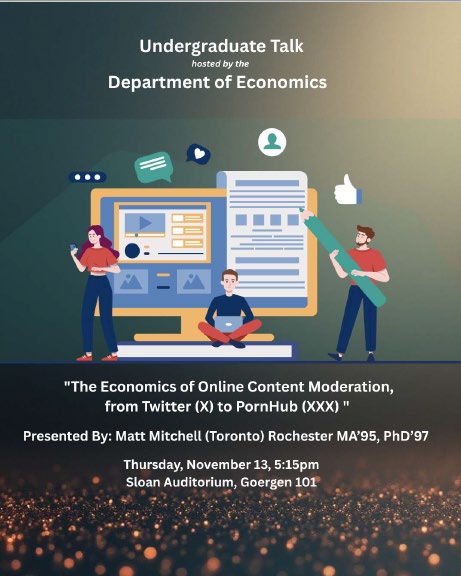
Date: Thursday November 13th
Time: 5:15 PM
Place: Sloan Auditorium (Goergen 101)
Who: Professor Matt Mitchell (Toronto)
What: “The Economics of Online Content Moderation, from Twitter (X) to PornHub (XXX)."
The talk is specifically aimed at undergraduates!
Additional events coming soon.
Some Things That Captured Our Attention
Rochester’s Sprawl Problem? ““The Sprawl Effect” will consider how to regain transit rich environments and adopt a 21st century approach to better connect people to resources. The event’s panelists are Aqua Porter, executive director of Rochester-Monroe Anti-Poverty Initiative, Miguel Velázquez, CEO of RTS, and Kevin Kelley, manager at office of city planning. Abigail McHugh-Grifa, executive director of Climate Solutions Accelerator will serve as a moderator, and Simeon Bannister, president and CEO of Rochester Area Community Foundation will provide opening remarks.”
Recycling Retardants: Don’t Use Black Plastics?
A Hopium Power Plant: “For solar to serve as the backbone of a grid, it needs to be backed with storage. That can come in the form of batteries, hydrogen, or pumped hydro. All of these are expensive; none of them scale. Storing a kilowatt-hour of electricity in a chemical battery costs an order of magnitude more than just generating it in a nuclear power plant. Which is why a 100% solar grid would be insanely expensive, even though generating solar power is basically free.” … or as I like to say, “TENTS are CHEAPER than HOUSES”
The Micron Factory, a $100 billion investment, in Syracuse: “Just over two years ago, Micron Technology announced it would build, with substantial help from taxpayers, the nation’s largest chipmaking complex in the northern suburbs of Syracuse. Construction was scheduled to start in June 2024. That was pushed back to early 2025. And now, groundbreaking won’t start until at least November 2025, nearly a year and half behind the original schedule.” “In the town of Clay, however, the 1,400-acre site where Micron proposes to build four massive factories remains heavily forested and brimming with wetlands. Micron’s only presence there are several plywood signs. The main reason for the holdup? Micron hasn‘t finished the massive environmental impact report required by the state and federal governments to move the project forward”
Here's more: “The Clay site is replete with wetlands, which can’t be filled in without special permission from the federal government. Also on the site are two species of endangered bats, which requires another level of federal review and limits when Micron can fell trees. Micron did not directly address why it hadn’t met the original timeline but hinted that the extensive environmental review is partly to blame.” OK, so maybe put the thing where there are NOT wetlands OR endangered bats? Or something?
“The Permian Basin, responsible for half of U.S. crude oil production, just got a much-needed boost from the new Matterhorn Express pipeline, which began operations last month. This 580-mile pipeline is critical for alleviating the bottlenecks that have plagued West Texas producers, forcing them to pay others to take their natural gas or simply flare it off. Matterhorn is now moving 2.5 billion cubic feet of gas per day from the Permian to Gulf Coast export hubs, helping stabilize gas prices that had plummeted to negative levels. This not only allows producers to ramp up oil output but also reduces environmentally damaging flaring. However, experts warn this relief may be short-lived—Permian gas production is expected to keep growing, and Matterhorn’s capacity could be maxed out by next year. The next pipeline, Blackcomb, isn’t expected online until 2026, so producers may face similar bottlenecks again soon.”
Capelin Destruction Measurement … and climate change of course
Inflation Reduction Act: “(Electric Vehicle Tax Credits in the IRA come) at taxpayer cost of $32,000 per additional EV sold. Compared to scenarios with no EV credits, however, the IRA EV credits created only $1.02 of benefits per dollar of government spending
Rachel Carson Would Surely Approve? “Wasps released on Nightingale Island have protected Wilkins’ bunting by halting spread of mould-causing insects”
Rachel Carson Would Surely Approve? Dextinction, Tasmanian Tiger Edition
A Different Kind of Fertility Externality: “Court documents explain that Schubarth worked with the other unnamed coconspirators to use MMK’s semen to artificially impregnate various other species of ewes — all of which were prohibited in Montana — and create hybrid animals. Their goal was to create a larger and more valuable species of sheep to sell to captive hunting facilities, primarily in Texas.”
Forever Chemicals Don’t Kill Turtles Though! “Paper straws contain more potentially toxic ‘forever chemicals’ than plastic. Should you give them up?”
EPA Imposes Lead Removal Rule on Utilities: “The new rule, which updates regulations under the 1991 Safe Drinking Water Act, also lowers the allowable amount of lead in the meantime to 10 parts per billion, from the current 15 parts per billion. If the water supply repeatedly exceeds the new threshold, utilities must make water filters available. Some public-health advocates had called for a lower standard of between zero and five parts per billion.” Did They Find the Golden Ticket? Lab Grown Chocolate
“More things I didn’t know: In a worst-case scenario where all crops die instantly, the US has enough stockpiled food (including animal feed) to last at least 18 months.”
Nature vs. Life “In contrast, the study also found that “ease of doing business” – a World Bank measurement of the business-friendly character of a country – was correlated with less nature connection. Although Britain is believed to have one of the highest levels of membership of environmental organisations in the world, this apparently pro-nature indicator was found to have little impact on closeness to nature.”
Gas, Awash in Gas: “Among the key advantages Bloom Energy cites for its burst of growth are incredibly short delivery times—the company promises first electricity within 90 days of orders—and the ability to reliably power data centers without a backup grid connection. Bloom’s chair and CEO, KR Sridhar, took a full victory lap during a call with investors on Tuesday:” “AI factories require infrastructure that tightly integrates compute, power, data center
architecture, and capital. Bloom Energy’s fuel cells deliver reliable, scalable and clean onsite power that can be rapidly deployed without legacy grids” In a few years, the world will be awash in ways to convert natural gas into electricity even more efficiently and cheaply than is done now. Once this inevitability reveals itself, the benefits accrued to the US by its massive gas reserves and unparalleled array of gas collection and separation plants, crisscrossing pipelines, and other midstream assets will only grow
Are We Building Back Better? “Onshored Solar Supply Chain? The U.S. just quietly crossed a milestone: it can now manufacture every major solar component domestically. With Corning’s new Michigan ingot and wafer plant online, SEIA says the full solar supply chain—from silicon to module—is now onshore. Capacity has exploded: modules up 37% since last year, cells tripled, inverters up 50%, and battery cell production closing in on 100 GWh. In less than two years, America has gone from lagging to leading in solar hardware. The next challenge: staying competitive. Labor, energy, and compliance costs will test whether “Made in America” can mean both secure and affordable as the Inflation Reduction Act’s manufacturing incentives phase toward real market economics.”
Batteries Limit Rolling Blackouts
““red-winged blackbirds and real estate booms can not inhabit the same swamps contemporaneously.” It wasn’t any one party that was clearing the country of birds. Rather, it was all of them together: civilization was a disease.” … Even so, the survival of cranes and condors is no more inevitable than was the extinction of Passenger Pigeons. And it was precisely the alarm over their destruction that mobilized concrete, and eventually radical actions to protect the country’s birds. These actions were too late for the Heath Hen, Ivory-billed Woodpecker, and Eskimo Curlew. But with those tragic exceptions aside, I find it remarkable that all of the other species Hornaday marked for extinction are still with us today.”
Corals and Climate: “Even before the 2023 marine heat wave, staghorn and elkhorn numbers had been dwindling, with punctuated declines accelerated by a diverse array of stressors – hurricane damage, loss of supporting herbivore species, disease and repeated bleaching.”
Can a Carbon Tax Work in a non-Rich Country? Yes.
Solar Panel Tariffs: Bad for jobs, bad for consumers, bad for the planet.
Politics and Tesla Sales: “Using county-level, monthly data on new vehicle registrations, we leverage how changes in vehicle sales over time diverge across
counties with differing shares of Democratic and Republican voters. Without the Musk partisan effect, Tesla sales between October 2022 and April 2025 would have been 67-83% higher, equivalent to 1-1.26 million more vehicles.”
ANWR: “Nagruk Harcharek, president of Voice of the Arctic Iñupiat, a group that represents Iñupiat organizations on Alaska’s North Slope and supports oil and gas projects, said the move would provide economic benefits. He noted that taxes on local oil and gas operations had funded basic services such as schools and running water.
“You couldn’t graduate high school on the North Slope until the North Slope Borough built K-12 schools in all of the communities” using oil and gas revenue, Mr. Harcharek said.
But Kristen Moreland, executive director of the Gwich’in Steering Committee, a coalition of Gwich’in tribal members in Alaska and neighboring parts of Canada that opposes oil development, said drilling in the refuge could threaten caribou that her people have hunted for centuries.”
Burning Blades: “Even in the age of clean energy, 170-foot-long wind turbine blades are becoming a new environmental problem. Made of fiberglass and balsa wood, these massive structures are almost impossible to recycle, so most are burned in cement factories — a painkiller, not a cure, for the emission issue. Turning them into a pedestrian bridge in Ireland or a bike shelter in the Netherlands would make far more sense; yet sadly, burning them is still cheaper.”
Amazon Goes Nuclear: “Hyperscalers aren’t waiting for the grid; they’re becoming generators—and nuclear just graduated from talking point to project finance.”
Chart of the Week
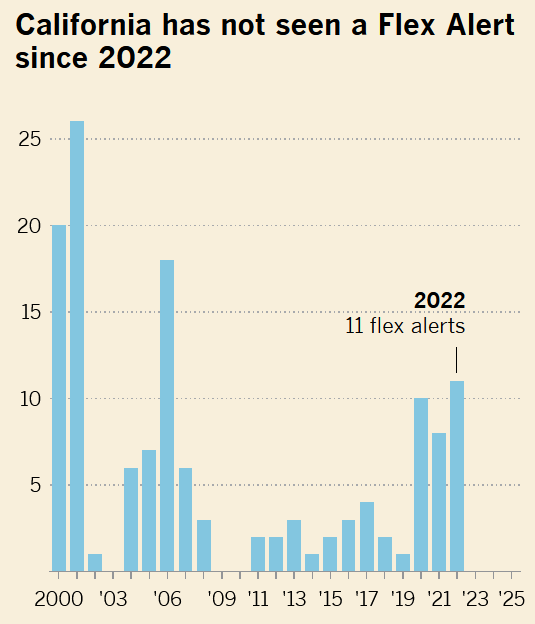
Photo of the Week
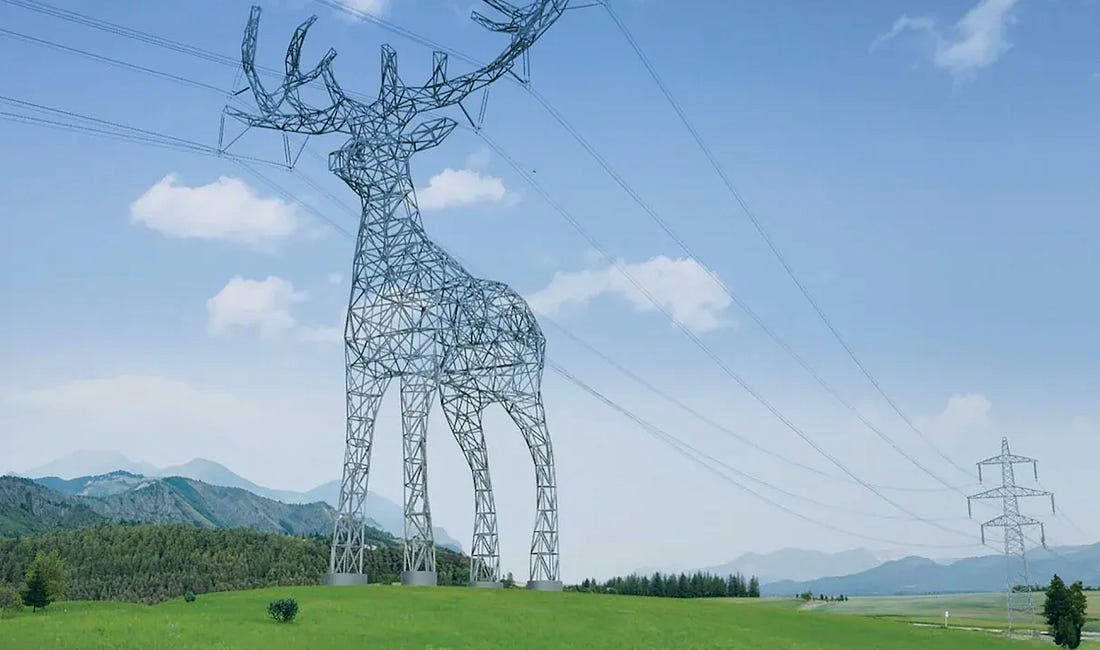
The Culture That is Scandindavia
Film, music, cultural item of the Week
MAKE THE TIME TO WATCH THE AMERICAS Wildlife Documentary from NBC and Tom Hanks. I always bring high hopes to these, and it did not disappoint.

They Said It
We are all experiencing more or less the same lifetime now.
What is it the slightly older people want from the slightly younger people? They want credit for having survived so long, and often imaginatively, under difficult conditions. Slightly younger people are intolerably stingy about giving them credit for that.
What is it the slightly younger people want from the slightly older people? More than anything, I think, they want acknowledgement, and without further ado, that they are without question women and men now. Slightly older people are intolerably stingy about making any such acknowledgement
- - Kurt Vonnegut, If This Isn't Nice, What Is?