WEEKLY REMINDERS/ANNOUNCEMENTS – Eco 238, Week 1
Topics and Readings This Week: We are going to start the course by exploring perceptions and doing triage on environmental problems, discussing risk and diving a tiny bit into the history of the environmental movement.
Please bring $5 to our first class (sometimes we don’t pay/collect until class two, but be prepared)
If you prefer, we can use Venmo (@wintercow20).
Please make your way through the readings in Section One.
If you read anything for the first class, please read Laurence Tribe’s instrumental piece on Ways to Not Think About Plastic Trees (it’s also part of the first homework).
Or Don’t Read Anything At All - the UNReading List: https://chatgpt.com/g/g-6a7d3889c1088191a8c5c4ae54c87fbe-the-environmental-economics-unreading-list
We built this module as MUCH MORE than a reading tool, it is a course and ideas synthesis tool. If you are not going to read the reading list, it is imperative you gain familiarity with this tool.
Syllabus: Please read it through, carefully. Make note of all important dates on your calendars now; start organizing your projects now.
Or DON’T Read the Syllabus: We built this artifact to answer any and all course questions you might have: https://claude.ai/public/artifacts/02ec75c3-69a3-40b2-9dc5-023199d9eb8d
If you have any admin questions, I would first read the syllabus, then confirm with the AI, then find a TA, then find the Head TA, and if and only if your admin questions are not answered by then, would you ask me. I will not return emails or texts that have answers on the syllabus and AI.
Assignment Admin Notes and To Dos
In the Weekly Assignments and Class Updates folder you should be looking for three elements.
Each week has a folder containing the relevant assignment and supporting materials
At the top of the section you will find directions for “Setting Up Your Github Public Course Repo” as a substantial amount of your work this year is going to be shared publicly and evaluated on the quality of your public engagement. No more chatGPTed or friend copied work just sitting dead in Blackboard anymore. In other words, “Show Me.”
A grading guide for you. We outlined, with the assistance of our AI, a general set of guidelines for how we will be evaluating most of your assignments. Note we are no longer assigning work with specific point totals or weights. We are no longer giving points or taking off points for particular boxes checked. We are evaluating the overall quality, engagement, humility, authenticity and economic quality of what you produce.
In other words, there is no specific “rubric.” Do good work. Care. Engage.
You no longer just get 10 out of 10 or 9 out of 10s for doing good work. Consider an 8 out of 10 an excellent score that shows you completed the tasks well. See the assignments themselves and grading document for more specifics. We are not here to grade inflate or normalize average or subpar work. No more. And yes, that is part of a large externalities problem that we are aiming to start solving.
THREE EXEMPTION POLICY and MISSED Assignments
All assignments must be completed unless covered by an exemption.
All students are given a NO QUESTIONS ASKED 3 exemptions policy.
You do NOT HAVE to use the exemptions
You can use 0, 1, 2 or 3
But if you are late on an assignment, have a travel conflict, are too sick to get work done, messed up formatting or submissions, can’t dedicate your best efforts for the week, are having personal troubles that week, etc. you MUST take an exemption.
There are no extensions, no late work, no make-ups. The exemption policy is built to be the pressure release valve for any conflict.
Your RRR grade will be calculated based on all of the work you submit. Your RRR percentage will equal the total points you earn divided by the total points possible on all RRR assignments that you submit and that are not covered by an exemption. An assignment missed after all three exemptions have been used will count as a zero and will also reduce the final weighted course average by two percentage points.
So, for example, if each assignment is worth 5 points, and we offer 12 weeks of research assignments and you complete 12 weeks of work and use no exemptions, your research grade will be computed as “total number of research points obtained divided by 60.”
If for some reason you used 2 of the 3 exemptions, your grade calculation is “total points scored divided by 50”
If you took all 3 exemptions AND missed an additional assignment, your grade calculation is, “total points scored divided by 45” AND THEN we reduce your entire final weighted course average by 2 percentage points.
We score every assignment submitted. In other words, you may NOT use your exemptions and ask us to take your “best 9 assignments.” Anything submitted will be counted toward your course grade.
We are very likely to be offering one or more “double assignments” which will count as two weeks’ worth of your grade. Skipped double assignments would count as two exemptions.
Homework is intended to drive learning and growth mostly outside of the materials we are covering in lecture itself. Treating homework like a bare-minimum requirement that just needs to be completed reduces not just the assignment, but the course itself, to the bare minimum. Education is supposed to be about so much more than just handing things in. Otherwise, why are you here?
The EXEMPTION program is NOT meant as a way for you to strategically pick which assignments are tougher or not work when you are not in the mood. They are built in as course relief valves in the case of a misstep, mistake, unavoidable last-minute conflict, submission error, late work, family emergency, acute illness. So you are strongly advised to try to leave at least one assignment exemption in reserve in case a mistake appears. The program exists to cover contingencies, not as a strategic grade tool.
Setting Up Your Public Course Portfolio
What this is
Starting this semester, your written work for ECON 238 lives on a public site you build and control — not a text box in Blackboard. You'll submit a link to your own page for each assignment. Do this setup now; every assignment sheet going forward assumes it's done.
Part 1 — Build the site (~15 minutes, no coding required)
Create a GitHub account at github.com if you don't already have one. It's free.
Create a new repository.
Click the + in the top right → New repository
Name it econ238-portfolio
Set visibility to Public
Check Add a README file
Click Create repository
Turn on GitHub Pages.
In your new repo, go to Settings → Pages
Under "Build and deployment," set Source to Deploy from a branch
Set Branch to main, folder to / (root) → Save
Wait a minute, refresh — GitHub will show your live URL
Confirm it's live at https://<your-username>.github.io/econ238-portfolio/. Right now it's just showing your README — that's about to become your homepage.
Everything above and everything from here happens in the browser: Add file → Create new file, or the pencil icon on any existing file. No git, no terminal, no command line required. (If you already know git and want to work locally, that's fine — it's the same repo either way.)
Part 2 — Structure
README.md is your homepage. GitHub Pages renders it automatically — no extra setup.
One markdown file per assignment: assignment-01-<short-topic>.md, assignment-02-<short-topic>.md, etc. Each becomes its own page at its own URL.
Link every new assignment file from your README as you add it, so your homepage doubles as a table of contents.
Part 3 — Your README
Replace the default content with something like:
# [Your Name] — ECON 238 Portfolio
Environmental Economics, Fall 2026, University of Rochester
## Assignments
- [Assignment 1: Coase and the ___ dispute](assignment-01-coase.md)
Add one line to that list every time you add a new assignment file. That's the entire homepage-maintenance job.
Part 4 — Submitting work, going forward
For each assignment:
Add or edit the relevant .md file.
Commit the change (the web editor prompts for a commit message — write a real one).
Copy the URL of that specific page, not just your repo's root.
Paste that URL into the Blackboard assignment by the deadline.
Blackboard stays the official deadline and grade record. Your site is where the actual work lives.
A handful of small commits spread over several days reads very differently than one commit at 11:58pm the night it's due. Build the habit of saving as you go.
Part 5 — Name or handle
Real name is the default, and it's the stronger choice — this becomes a portfolio piece, and "here's my public work from college" is worth more attached to your actual name. If you'd rather not have coursework permanently attached to your legal name in a public search, email me and use a consistent handle instead; I'll map it to you privately. Whichever you pick, keep it the same all semester.
FAQ
Does this cost anything? No. Public repos and GitHub Pages are free.
Can I make it private? No — the point is that it's public. If you have a real concern about that, email me directly rather than working around it on your own.
What happens to it after the semester? It's yours. Keep it, add to it, put it on your resume.
I already have a GitHub account or site from another class. Fine — just add this repo to your existing account.
Week One Assignment:
Your first assignment has been posted and is due uploaded to Blackboard before 6:59pm on Sunday, September 6th
Read the instructions clearly, and follow the correct submission protocol
Week Two Assignment:
Next week is Labor Day, so you have a long three day weekend just one week into class. So you do not yet have a lot of work assigned, you do not yet have a million other course commitments, and the weather is likely to be warm. So it is a great chance to GET OUTSIDE.
We do not have the full assignment posted, but we WILL be asking you, for a large portion of the work, to execute the Get Outside project. And since you can plan NOW for what you may do over break, we posted the Get Outside instructions in the Week Two Assignment folder.
In other words, get started on the Get Outside Project.
Form Your Groups, Start Your Projects: All of the details on the what/how/who of the group projects can be found under, “Projects” on Blackboard.
In addition, to aid you in finding group members (I encourage you to mill around before or after lecture, but I know some of you don’t love that idea) there is a tentative class list posted in the “Syllabus ...” folder on Blackboard. Excellent projects are those that are pondered and discussed and debated all semester long. It will be evident if you do or do not do this. Note that Professor Rizzo grades all non-weekly work for the course.
Our TAs will assist you in finding a group if and only if you have tried unsuccessfully for the first two weeks of class.
TA Office Hours and Info: Look for an announcement from our Head TA Jingyao Wu for an update.
The TAs are going to offer office hours and weekly discussion sessions which will enable you to explore class topics more deeply, and to dive into portions of the weekly class work (and possibly receive credit for doing so).
My Availability:
I make myself very available by phone, text or email during the week. I am moving to not being on or near electronics over the weekend. If you have needs or questions over the weekend, run them through the TAs.
For the most up to date info on my office hours availability, and campus whereabouts and other ways (possibly) to meet and get in touch with me, check this announcements page each week.
To access our updated office hours schedule (and for additional econ information including internships, grad school, special events, ideas to discuss, etc.) visit our Office Hours Blackboard page at tiny.cc/RizzoHours. I update my calendar weekly on that page (or more frequently), and include other sometimes useful information on it for you.
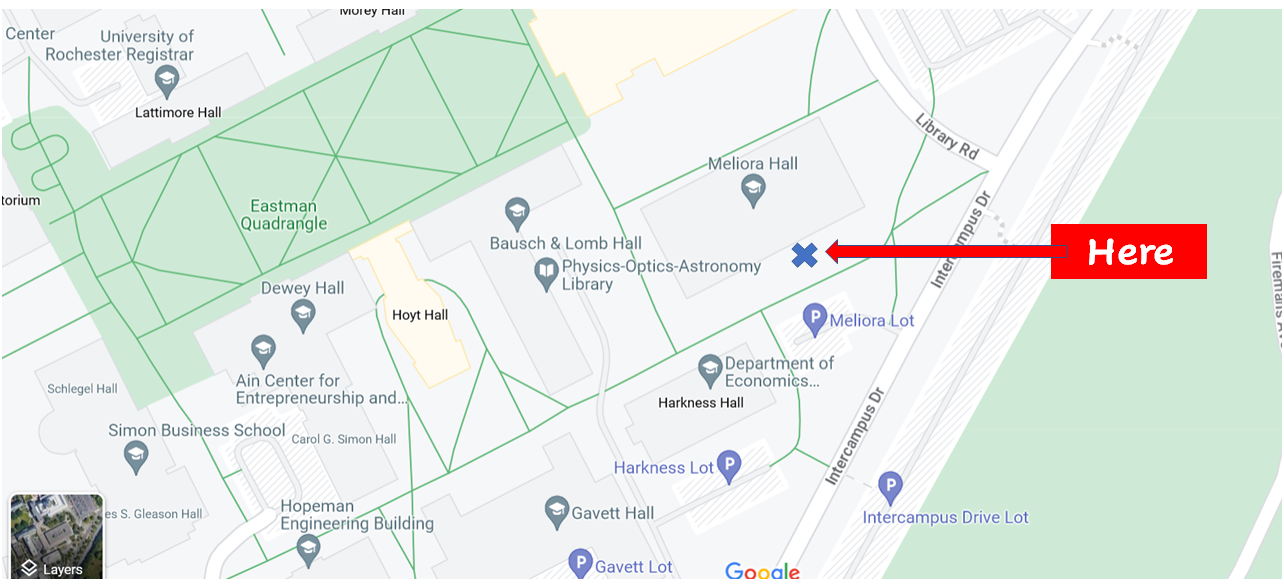
We walk over to the picnic tables right after the 10:25 Econ 108 class gets out (I may run up to my office first to grab extra folding chairs). Folks tend to drop in at all times from anywhere from 2 minutes to 75 minutes, so we hope to see you outside of class.
Upcoming Special Events
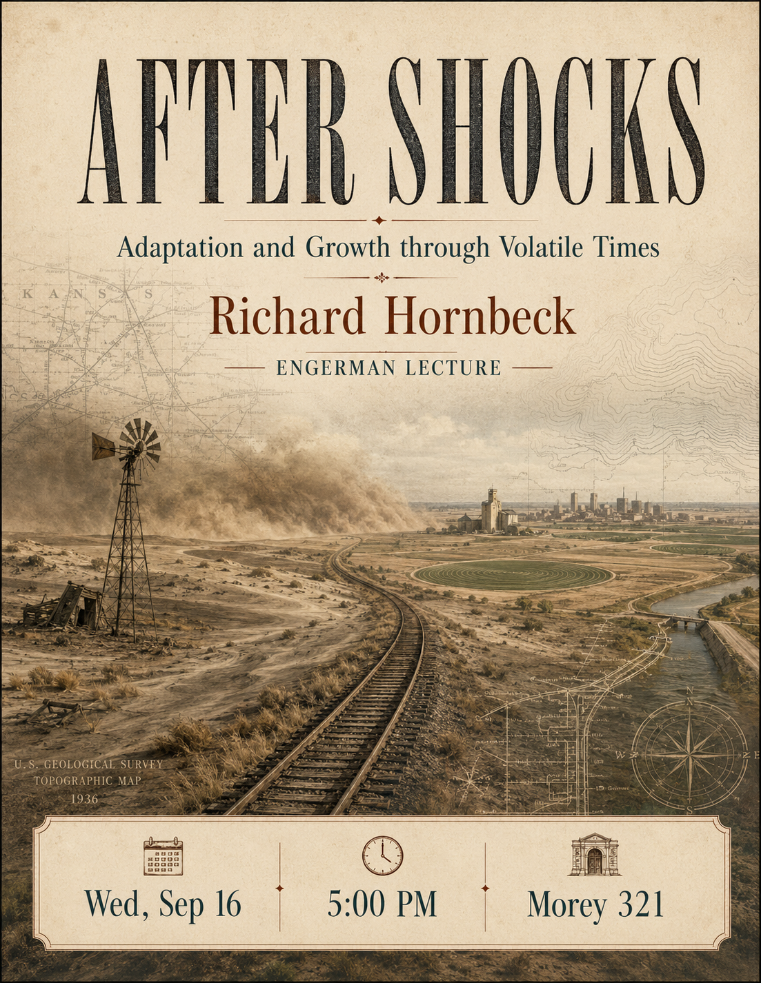
Department of Economics Engerman Lecture
“After Shocks: Adaptation and Growth through Volatile Times”
Who: Rick Hornbeck of the University of Chicago
Professor Hornbeck is the V. Duane Rath Professor of Economics at the University of Chicago Booth School of Business. He is a leading applied microeconomist and economic historian whose research explores the historical development of the American economy. By combining massive, newly digitized historical datasets with modern economic theory, his work uncovers the fundamental, long-term drivers of wealth, productivity, and living standards across generations. Professor Hornbeck’s research frequently reshapes how we understand major historical shifts and crises. His famous studies look beyond traditional metrics to evaluate the enduring economic footprint of environmental disasters like the 1930s Dust Bowl, the systemic human gains of post-Civil War emancipation, and the massive aggregate wealth generated by historical infrastructure expansions like the American railroad network. He holds a Ph.D. in Economics from the Massachusetts Institute of Technology (MIT) and previously served as the Dunwalke Associate Professor of American History in the Economics Department at Harvard University.
Day: Wednesday, September 16th
Time: 5:00pm
Where: Morey 321
The Politics and Markets Project, Hosted by Professor David Primo
Title: Topic TBD (this will be a moderated panel discussion)
Date: Wednesday, November 4th
Time: 7:30pm to 8:30pm
Location: Wegmans Hall, 1400.
More Info on the PMP: Follow on Instagram
Department of Economics Special Guest Lecture
Title: Human Capital for Humans, with moderation by U of R Economics Undergraduate Isaac Miller
Who: Pablo Pena of the University of Chicago
Date: Thursday, October 8th
Time: 3:30pm
Location: Morey 321
More Info: Why do people marry, have kids, invest in health, or choose a career? Economics has an answer, and it's not "supply and demand," it's human capital theory, the framework Nobel laureate Gary Becker built and spent his career applying to every domain of human life. Pablo Peña studied under Becker at Chicago, taught his famous course after him, and has now written the accessible version of that legendary class: Human Capital for Humans.
Join us for a talk and conversation with Professor Peña about the book — how economists think about parenting, aging, marriage, and the everyday decisions that shape who we become. Expect a short talk, a moderated discussion, and open Q&A. Copies of the book will be available for purchase (and signing) at the event.
About Professor Pena: Pablo Peña first encountered human capital theory twenty years ago as an undergraduate captivated by a course taught by Nobel laureate Gary Becker at the University of Chicago — an experience he's described as immediately clarifying. That encounter led him to TA the course, and eventually to teach it himself. Peña is now an Associate Instructional Professor in Economics and the College at the University of Chicago, specializing in applied price theory, human capital theory, and empirical economics, and his research uses experimental and quasi-experimental methods and large datasets to test economic theories with actionable applications for business, nonprofits, and government. Outside academia, he co-founded Microanalitica, previously served as Director of Private Sector Partnerships at the Development Innovation Lab, and headed Economic Studies at Mexico's National Banking and Securities Commission. He earned his Ph.D. in Economics from the University of Chicago.
His book, Human Capital for Humans: An Accessible Introduction to the Economic Science of People (University of Chicago Press, 2025), has been nominated as a finalist for the Manhattan Institute's 2026 Hayek Book Prize, and has drawn praise from economists including Steven Levitt, Tyler Cowen, and Nobel laureate Michael Kremer.
Additional Events: Please check our office hours site regularly for updates on additional events.
SOME THINGS THAT CAPTURED OUR ATTENTION
Antiobioticless Antibiotics? Julian Simon wins again? “Reprogrammed immune cells in chickens may protect the animal from bacterial infections without the use of antibiotics, an in vitro study yesterday revealed. The finding could help reduce antimicrobial resistance and affect farming practices for the estimated 27 billion chickens or more alive at any given time”
Dobby Denies Green Energy Project: “A £430 million British energy project was forced to reroute after pushback from critics, who complained that… wait no… no please tell me this isn’t real… Y’ALL, THEY REALLY DIVERTED A POWER LINE BECAUSE OF DOBBY THE ELF FROM HARRY POTTER I’M ROLLING (JK, ROWLING) ON THE DAMN FLOOR RIGHT NOW. Context: a Greenlink undersea cable was set to deliver solar and wind power between Ireland and the UK… but after project director Simon Ludlam described the plans on BBC Wales, Potter fans sounded the alarm — this thing would go right through Dobby’s ‘grave’ (the filming location where Dobby is laid to rest, and where fans have built an actual, real-life ‘memorial’). Was the project ultimately delayed as a result, and forced to go near “real Bronze Age remains” instead? Yes and yes. But before Brits whine about their precious ‘energy’ and ‘keeping grandma’s dialysis machine powered,’ stop and think: is this really more important than defeating Lord Voldemort?”
Declining Swimmers? Maybe not. “Sperm concentration remains stable among fertile American men: a systematic review and meta-analysis”
When You Need Power, You Use Gas. Period. You want to regulate reliable power out of existence? Complain about data centers? Fine, we will do it ourselves. Amazon building 7.6GW of natural gas power plant for itself.
Abundance for Thee, But Not for Me: “Of course, a compromise would be to have a smaller park (25 acres) and use the rest of the land for housing. While economists, think about land use at the margin ; the policy makers in the wild town of Santa Monica have locked in with an “all or nothing” mindset. The Beach is just 2 miles away and its walking trails are sufficient “park land”. I view this to be another wasted opportunity. The sad irony is that I bet that many residents of Santa Monica have read the Abundance book by Klein and Thompson and agree with the authors but they also support building this park.”
Wildlands Festival raises $600,000 for Yellowstone Conservation initiatives at PERC. And Senators touch grass, it’s a good thing.
Why We Can’t Build, Episode 3558827.335 Micron Edition: Lawsuit challenges Micron’s air, wastewater permits granted by NY. A new lawsuit alleges that the permits issued for the sprawling Micron Technology chipmaking complex in the town of Clay will allow Micron to pollute the air and water with toxic chemicals. The suit, filed Friday in Albany County, says the New York State Department of Environmental Conservation failed to set safe limits on the emission of toxic chemicals into the air and their discharge into the Oneida River, including so-called “forever chemicals.” Instead, the suit charges, the DEC issued the permits and indefinitely postponed the setting of safe limits and safety measures. The suit was filed by citizens group Neighbors for a Better Micron and the national labor advocacy group Jobs to Move America.
The Poor Pay for the Carbon Tax: “The American Economic Review will publish a paper that uses data from Europe and a mathematical model to document that poorer people bear the brunt of carbon taxes. Their incomes decline, their unemployment risk increases and the prices of goods they consume rise.”
Drowning Goodheart: Even on freak days when the sky pissed rain, the farms of Patrick Esch and Ed Dean Jagers remained bone-dry. Parched became payday. In one of the most madcap crop insurance scandals on record, Esch and Jagers turned moisture misery into a multi-million-dollar heist. The Colorado cowboys stole $6.5 million worth of raindrops.The “odd things” occurred at weather stations (900 operate nationwide) located from Colorado’s Ellicott to La Junta to Ordway to Springfield to Walsh, or across the state line into Kansas from Syracuse to Coolidge to Elkhart, and beyond. Whether publicly positioned alongside airports, or discretely hidden on desolate grassland backroads, a minimum of 16 stations were vandalized or manipulated. NWS personnel reported a surreal litany of $11,000 in damage to rain gauges: funnels siliconed, bowls tipped, wires cut, parts shotgunned, bolts loosened, and more. Adios to rainfall recordings.
WWCS: Throwing some shade on Coase, beach edition
Green Gas: Fracking reduced emissions per capita by 7.5% and accelerated move to renewables
Ban Drinking: Paper straws have more forever chemicals than plastic straws
CHART(S) OF THE WEEK: Is Europe’s Wildfire Year Bad? Good? Bad Again? As always, it depends.
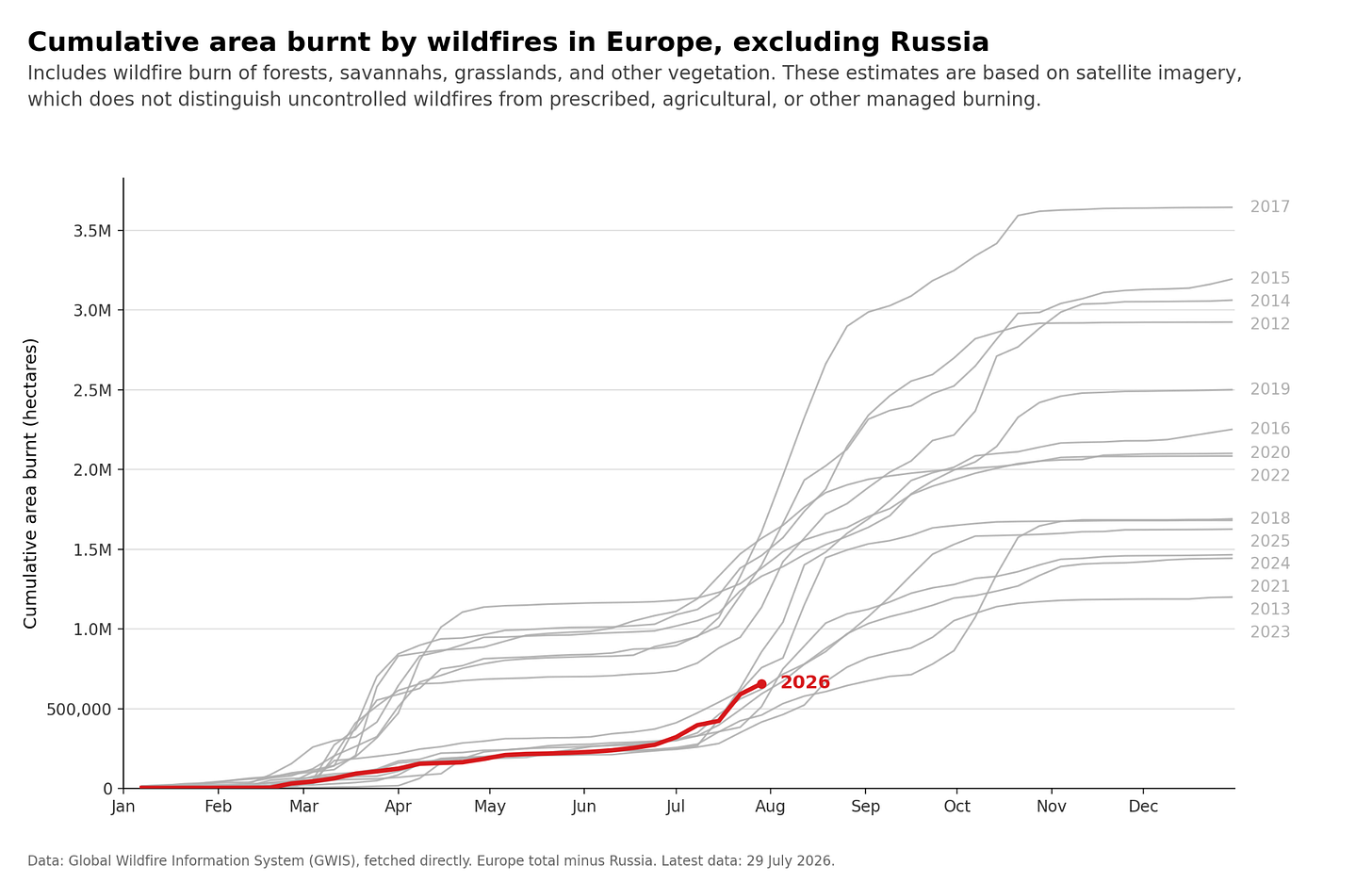
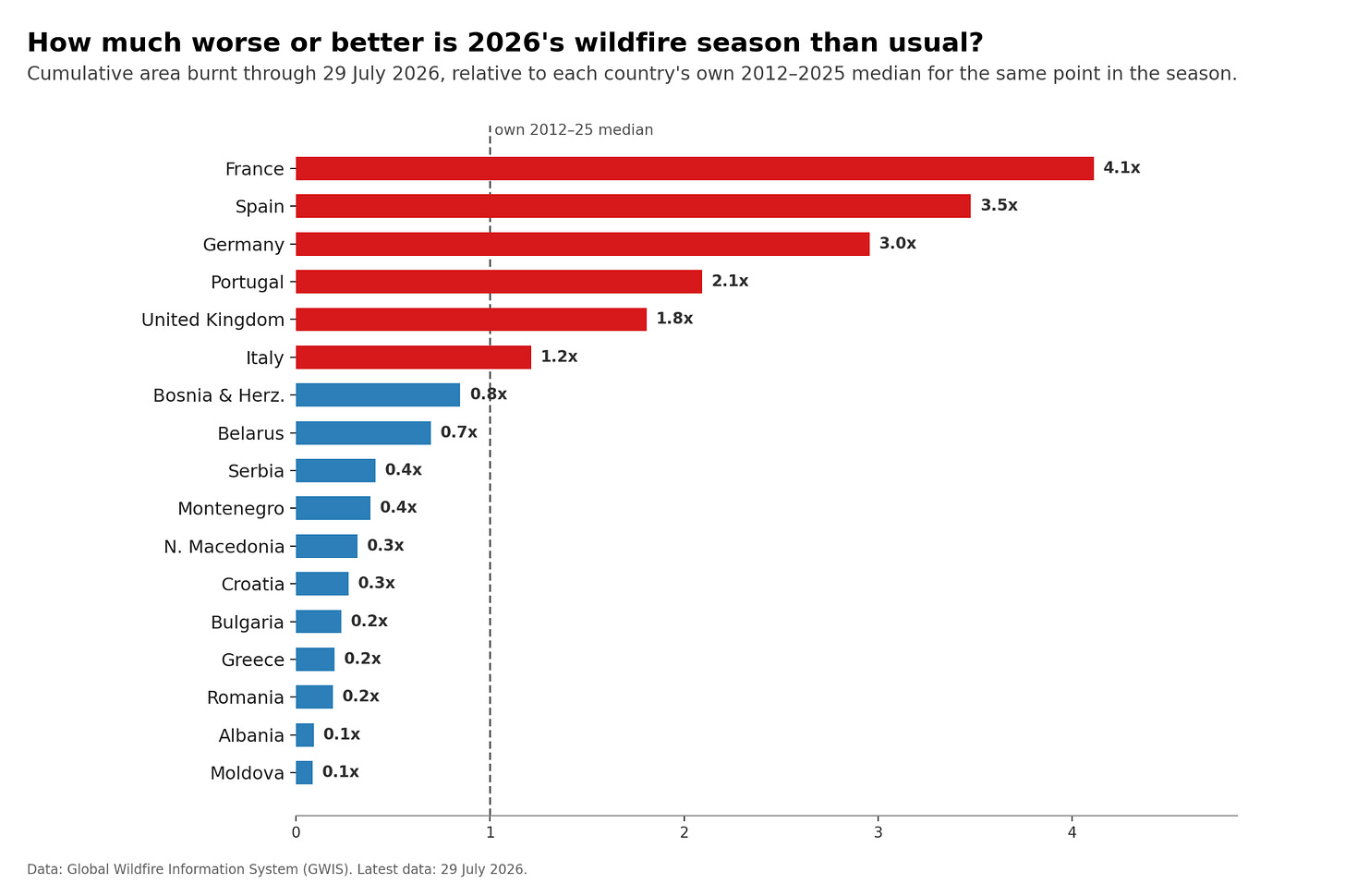
PHOTO OF THE WEEK: Book toilets

VIDEO/DOCUMENTARY/BOOK/CARTOON, ETC OF THE WEEK: What did nature look like for Lewis and Clark?

* * * * * *
Quote of the Week
Old pirates, yes, they rob I
Sold I to the merchant ships
Minutes after they took I
From the bottomless pit
But my hand was made strong
By the hand of the Almighty
We forward in this generation
Triumphantly
Won't you help to sing
These songs of freedom?
'Cause all I ever have
Redemption songs
Redemption songs
Emancipate yourselves from mental slavery
None but ourselves can free our minds
Have no fear for atomic energy
'Cause none of them can stop the time
How long shall they kill our prophets
While we stand aside and look?
Ooh, some say it's just a part of it
We've got to fulfill the book
Won't you help to sing
These songs of freedom?
'Cause all I ever have
Redemption songs
Redemption songs
Redemption songs
[Acoustic Break]
[Verse 3]
Emancipate yourselves from mental slavery
None but ourselves can free our minds
Whoa! Have no fear for atomic energy
'Cause none of them-ah can-ah stop-ah the time
How long shall they kill our prophets
While we stand aside and look?
Yes, some say it's just a part of it
We've got to fulfill the book
[Chorus]
Won't you help to sing
These songs of freedom?
'Cause all I ever have
Redemption songs
[Outro]
All I ever have
Redemption songs
These songs of freedom
Songs of freedom
― Bob Marley and the Wailers, Redemption Song