Course timing and readings
I will be finishing up our intro materials hopefully by Wednesday and then by end of the week we will be moving onto our Economic Evolution materials (Sections B and C). Please read at your convenience. I WILL be doing my own interpretation of the i,Pencil article, so if you have not read it, please do.
Assignments and due dates
Your week two research and rumination assignments are due this Sunday night, September 7th. I have had many questions regarding Part 2 of the Research Assignment, I am NOT asking you to actually read ANY papers. Get onto EconLit AND ChatGPT AND Elicit and Google Scholar if you must, scan the titles and abstracts, and get a sense for what the corpus of the literature is saying. We care about you using your brain to do a synthesis. And NO, we do NOT want a huge bibliography.
I have also just posted your two assignments that are due for Week Three on Sunday the 14th. These are both shorter than the week two assignments but of course the sooner you start them the better. The rumination will be your first opportunity (of many over this upcoming year) to work collaboratively with your peers on the work. Please follow our instructions and be sure to submit the proper assignments into the proper locations.
My advice on the ruminations in particular – make it clear you actually engaged the readings/ideas, but do not overdo them. I am hoping you use these to inspire conversation outside of class, at office hours, or have you think more carefully in general.
Our aim with grading your work is to have it done one week after submission. You can find the name of your grading TA by comparing the weekly TA announcement (which indicates which TA is doing which grading group) with the grading group you are in (found in the Blackboard gradebook).
Exam information
Please make note of the Exam dates and times. The exams are held outside of class-time. Do not make travel arrangements that conflict with either of our two midterms or our final exam. We do make accommodations for students with University of Rochester conflicts. Your first exam is on Friday, September 26th. Yes, “it is on the test,” and be prepared to explain your thinking in clear, concise writing. EXAMS WILL NOT BE GIVEN PRIOR TO, OR SUBSEQUENT TO, THIS DAY. And yes, they are open book, open note, open internet, open ChatGPT. You just can’t communicate with anyone about the exam.
Recitation information
You will have your third recitation this week and it will be the first of several games you will be playing throughout the semester. The game is played in polisci classes, sociology classes, psych classes and elsewhere, and we will return to it throughout the semester and again in Micro, so we’d absolutely love to have you come and play hard! There will obviously be spoils going to the victors.
Other class admin, TA hours
Late Added the Class? You are responsible for making up missed class materials. If you missed Week One, we did not grade that week, so do not worry about missing it though I do think it was good practice for future work. You ARE responsible for getting the Week 2 work submitted on time this weekend.
TA Office Hours: Look for an announcement from Alexa!
My Availability: I am going to be off of electronics until Monday morning. Call or text me then if you would like to chat as I will not be on my computer. I can be reached at 585-478-2677.
For the most up to date info on my office hours availability, and campus whereabouts and other ways (possibly) to meet and get in touch with me, check this announcements page each week and/or subscribe to my Office Hours Blackboard page at tiny.cc/RizzoHours. I update my calendar weekly on that page, and include other sometimes useful information on it for you.
Note that next weekend (the 12th through the 14th) I will be completely unable to return calls or messages and am out of town until very late in the evening Sunday night. Please lean on your TAs over that weekend if you need to connect.
Thanks to those of you who dropped by for our outdoor lunch discussions this week, I really enjoyed them. I have asked the school if they can provide more seating or tables for us. Feel free to stop by to say hi, listen to what we are chatting about, share some questions, teach us something, whatever. Just come by.
Some Advice
Read through your notes casually once per week – this makes
exam preparation go much more smoothly.
Upcoming Special Events
Public Service Announcement
No One Dies Alone (NODA) URMC extends this mission to patients who are facing the end of life without loved ones at their side, or who do not qualify for hospice services.
Some patients may be eligible for hospice but are unable to access it due to bed/staff shortages or lack of awareness of hospice care. NODA volunteers step in to provide for these individuals.
If you are interested in volunteering, please fill out this short form. For more information or questions, contact Anika Sharma at ashar51@u.rochester.edu.
(Pr Rizzo: Anika was a former EWOT student, very engaged, she would love some participation)
Department of Economics Engerman Lecture
Who: Robert Margo of Boston University
A specialist in the history of the American economy with particular emphasis on the economic history of African-Americans, Margo is the author or co-author of 5 books and over 150 articles, book chapters and book reviews. He has served on the editorial boards of many journals, including the Journal of Economic History, the American Economic Review, and the Quarterly Journal of Economics; and he has served as editor or co-editor of the Southern Economic Journal and of Explorations in Economic History. He was elected a Fellow of the Cliometric Society in 2012.
Additionally, Margo is an accomplished performer on classical guitar, mandolin, renaissance and baroque lutes. In the Boston area, he performs regularly with the Providence (Rhode Island) Mandolin Orchestra and the New American Mandolin Ensemble.
When: Wednesday, October 15th
Where: TBD
What: TBD
The Politics and Markets Project, Hosted by Professor David Primo
Title: Topic TBD (this will be a moderated panel discussion, likely on immigration)
Date: Wednesday, November 5th
Time: 7:30pm to 8:30pm
Location: Wegmans Hall, 1400.
The Department of Economics will be hosting several additional events this fall, TBA, coming soon!
Expected Guests/Topics: Lorenzo Caliendo (late September); Paul Bloom on Empathy/Compassion; David Livingstone-Smith (philosopher); Victor Haghani (money manager)
Some Items That Caught Our Attention
This Ought to Be Front Page News, Right? “Contrary to received literature, women are more intelligent than men, compete when they should in risky settings, and are more literate.”
“Kapitalism” in the 21st Century: (or why we can’t have nice things, episode 38757829): “These people do not understand what Rick Beato is doing,” adds YouTuber Andy Edwards. And he offers his theory of UMG’s motivation: This is not about money. This is about power….They want to frighten people. They want to go to YouTube and say, ‘Look, if you want to deal with us, then you’re going to have to take anybody out. If we want them out, they get taken out.’ That is what this is about. Rick Beato is not big enough. Nobody ever has been with this industry.”
Can Fake Amazon Reviews Explain Grade Inflation? “Counterfactual policy simulations indicate that fake reviews reduce consumer welfare, shift sales from honest to dishonest sellers, and ultimately harm the platform. Welfare losses arise primarily from misinformation that leads to worse purchases. While mistrust also leads to purchasing mistakes, the consumer harms of mistrust are largely offset by increased price competition under a weakened ratings system.”
Share Your Typewriter Ribbon!
Like Summer Camp … but with more annoying counselors?!
Why We Can’t Build, Tony Soprano Edition: “Finally, the youngest mafiosos at the turn of the millennium are by turns ungovernable, lazy, insouciant, and stupid. Tony’s own son, Anthony Junior (AJ) is all of the above, having inherited all of his father’s egotism without developing any of his strength.” … “Neither the mafia nor the nation is profiting as a result because the men within the mafia are much the same as the men outside it: whiny, excuse-mongering, and underachieving.”
AI Detection Whack-a-Mole: an update on the latest state of the art detection tools, and the challenge of Type 1 and Type 2 errors
Take a Scalpel to Hospital Mergers? “… all US hospitals from 1996-2022, … Hospital mergers significantly reduce patient volume, increase prices, reduce employment, lower wages, and deteriorate quality of care, resulting in higher patient mortality.”
So, Should We Make Mamdani Free Grocery Stores More Widely Available? “Despite being of lower socio-economic status and intelligence, obese people are much less likely (about 20-25% per 5 BMI) to commit violent, property, and drug crimes than their normal-weight counterparts.”
Maybe We Should Call it SinglePlayer Health Insurance? “To reiterate, the key point in this piece is that high administrative costs in US healthcare are unlikely to represent “do-nothing waste.” Some of the purported costs are entirely fake. To include them in the possible savings of single payer shows either ignorance or dishonesty. Some of the costs are to prevent waste and fraud, which should be paid by Medicare now (although they are not). Of what is left, the cost of duplication pales in comparison to the plausible benefits of choice and competition in health insurance. When you put all of these together, the case for single-payer is nonexistent.”
Chinapitalism: “The Yangwang U9, BYD’s top-of-the-line sports car at $235,000, does a rolling “dance” to different tunes by bouncing up and down on its hydraulic jacks. Its seats are designed to clutch passengers so they don’t get tossed around”
* * * * *
Chart of the Week
In other words, is it possible that most countries undergo an engineer-to-lawyer shift as they get richer, because poorer countries just tend to need engineers a lot more?
I am always wary of explanations of national development patterns that rely on the notion of deep-rooted cultural essentialism. Dan presents America’s lawyerly bent as something that has been present since the founding. But then how did the U.S. manage to build the railroads, the auto empires of Ford and GM, the interstate highway system, and the vast and sprawling suburbs? Why didn’t lawyers block those? In fact, why did the lawyers who ran the FDR’s administration encourage the most massive building programs in the country’s history?
In fact, as Sine shows in another post, the U.S. dominated global manufacturing between the 1920s and the 1960s to about the same degree that China does now:
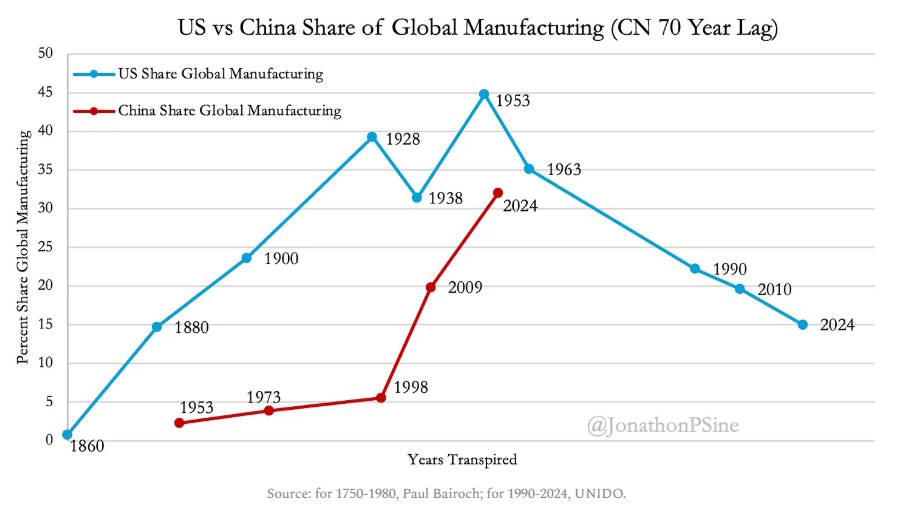
And keep in mind that America achieved this titanic share of global manufacturing while having a much smaller percent of world population than China does.
That’s an impressive feat of building! So even though most of America’s politicians were lawyers back during the 1800s and early 1900s, those lawyers made policies that let engineers do their thing — and even encouraged them. It was only after the 1970s that lawyers — and policies made by politicians trained as lawyers — began to support anti-growth policies in the U.S.
Photo of the Week
From Stalin’s Riverbank to Trump’s Cornfield: Make America ____ Again
“One of the country’s largest manufacturers is worse off now than it was six months ago. Last month, John Deere said net income in its most recent quarter was down 29 percent from a year earlier. Higher tariffs, primarily on steel but also on aluminum, have cost the company $300 million so far, with nearly another $300 million expected by the end of the year. This summer the company laid off 238 employees across factories in Illinois and Iowa.
Corn and soybean crop yields are expected to reach near-record highs this fall, according to projections from the Department of Agriculture. While that’s good news if there are plenty of buyers — U.S. farmers exported $13 billion worth of soybeans to China in 2024 — new tariff policies have weakened demand from China.
After Mr. Trump announced steep tariffs on Chinese goods this year, China placed retaliatory tariffs on U.S. soybeans in March. Soy exports to China are down 51 percent this year, and the country hasn’t made any advance purchases of soybeans for the upcoming harvest. U.S. growers are expected to receive $3.4 billion less for their soybean crop than they did last year, according to the Agriculture Department.
Corn and soybean crop yields are expected to reach near-record highs this fall, according to projections from the Department of Agriculture. While that’s good news if there are plenty of buyers — U.S. farmers exported $13 billion worth of soybeans to China in 2024 — new tariff policies have weakened demand from China.
After Mr. Trump announced steep tariffs on Chinese goods this year, China placed retaliatory tariffs on U.S. soybeans in March. Soy exports to China are down 51 percent this year, and the country hasn’t made any advance purchases of soybeans for the upcoming harvest. U.S. growers are expected to receive $3.4 billion less for their soybean crop than they did last year, according to the Agriculture Department.”
On the other hand, corporate tax rates were slashed by 35 to 21 and new tax depreciation rules are in place … but …

Film, music, cultural item of the Week
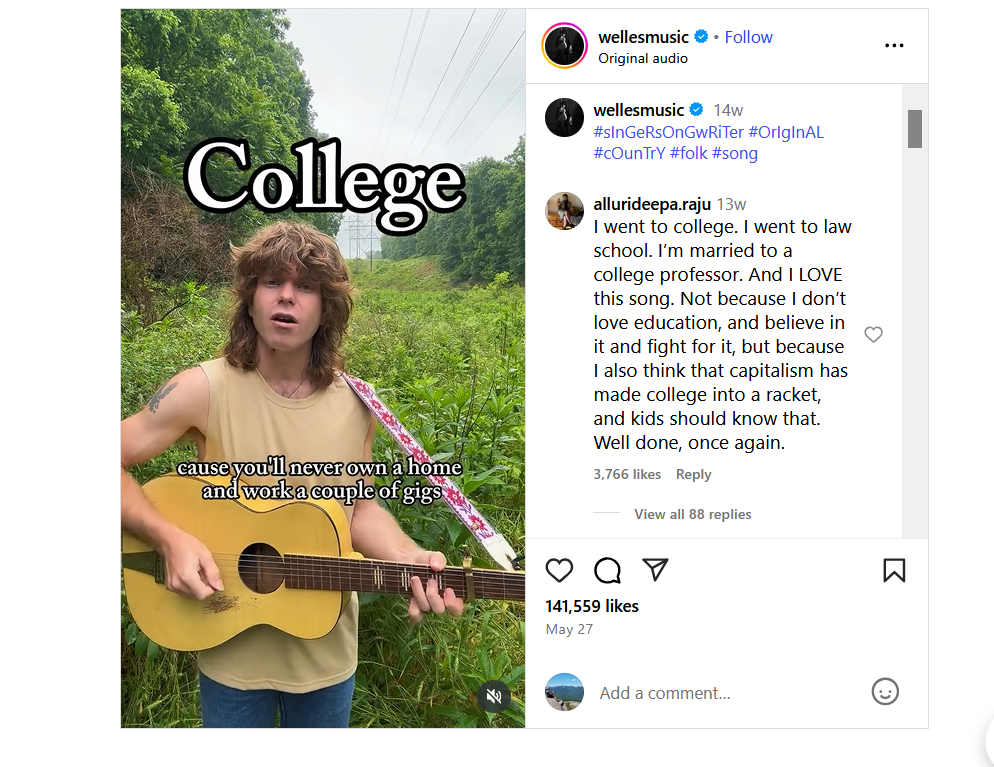
This video proves the rule of Never Reading the Comments
They Said It
“When Archibald and Lipsey try to draw for Patinkin a picture of what a “classical” monetary theorist believed in, they are pretty much in the position of a man who, looking for a jackass, must say to himself, “If I were a jackass, where would I go?”
Mine is the great advantage of having once been a jackass.”
—Paul Samuelson, What Classical and Neoclassical monetary theory really was
MJR: Has to be in the top 10 economics quotes ever