Course timing and readings
We will be moving toward the end of our exploration of our Economic Evolution – examining how closely the improvements in our ability to produce goods and services may correlate with changes in other aspects of our lives we value. We will then be moving on to the primary question of “how did all of this happen” and “can we continue to do it?” along with pondering some of the undesirable consequences of our growth experience.
You can continue reading through BOTH Sections B and C of the reading list at your leisure.
Assignments and due dates
Remember that for this exam week, Week 5, your Research and Rumination assignments are the same. So there is only one thing to submit. If you skip this week, that will count as both a skipped research and rumination.
Your Week 6 assignments are also up. The research is going to have you explore exactly HOW it is that poor people have emerged from poverty over the past several decades, but you are going to have to engage some others in the conversation. Your rumination, well, it will be some creative conjuring!
Exam information
Exam: I hope you had as much “fun” taking the exam as I had writing it! We will not be posting solutions to the exam. Your TAs will be available to discuss the suggested solutions during office hours and again during recitation. We aim to have the exam grading turned around within a week -- please look for Katherine’s updates for most up-to-date information.
Your recitation TA will have your exams once they are graded. Before you ask about the exam, please read the syllabus regarding grading and exam policies.
Recitation information
A different kind of Love Island! We are gonna match the fancy way this time.
We WILL have recitation this week. Is it magic? How the heck can “markets” use knowledge and clear? We will be playing a dynamic double-oral auction game in recitation this week (and again next week with additional applications). I think this will be a fantastic way to “see” how supply and demand works, and will make the analytics/graphs much easier to feel and understand when we get to that at the end of the term. Please make sure you let your TAs know if you are coming because we need to understand numbers in order to do this exercise well.
Other class admin, TA hours
TA Office Hours: Look for an announcement from Katherine!
My Availability: I am off-grid for most of the weekend. For the most up to date info on my office hours availability, and campus whereabouts and other ways (possibly) to meet and get in touch with me, check this announcements page each week and/or subscribe to my Office Hours Blackboard page at tiny.cc/RizzoHours. I update my calendar weekly on that page, and include other sometimes useful information on it for you.
Upcoming Special Events
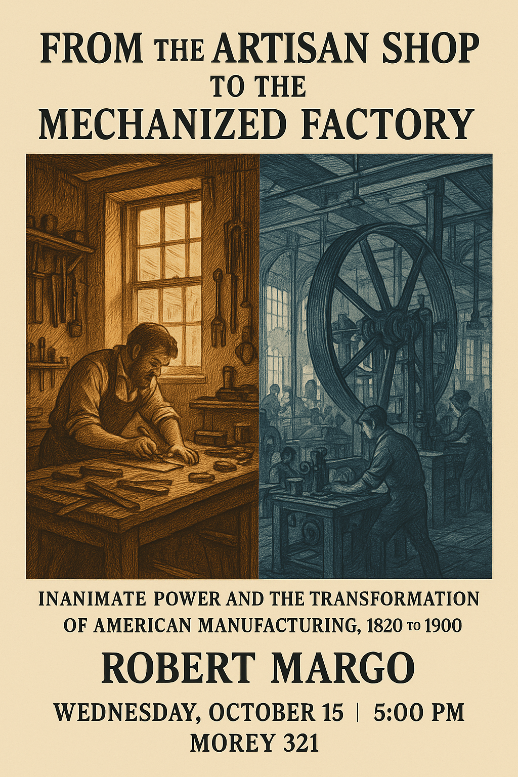
Department of Economics Engerman Lecture
Who: Robert Margo of Boston University
When: Wednesday, October 15th
Time: 5:00pm
Where: Morey 321
What: From the Artisan Shop to the Mechanized Factory: Inanimate Power and the Transformation of American Manufacturing, 1820 to 1900
The Politics and Markets Project, Hosted by Professor David Primo
Title: Topic TBD (this will be a moderated panel discussion, likely on immigration)
Date: Wednesday, November 5th
Time: 7:30pm to 8:30pm
Location: Wegmans Hall, 1400.
The Department of Economics will be hosting several additional events this fall, TBA, coming soon! We had a GREAT turnout for this week’s event.
Expected Guests/Topics: Paul Bloom on Empathy/Compassion; David Livingstone-Smith (philosopher); Victor Haghani (money manager)
Some Items That Caught Our Attention
Miss … is … sip … peeee: “By 2022, test results showed that — factoring in demographics — Mississippi elementary schools had the best reading performance in the country.”
Who Wants to Bet? Will NASA get these astronauts around the moon by February on Artemis II?
Economics 3.0: Claude?ChatGPT can pass the hardest level CFA exam in minutes.
Economics 2.0: “For the first time in history, UNICEF reports that the number of children with obesity has surpassed the number who are underweight worldwide. Today, one in 10 children is obese and one in five is overweight. In low- and middle-income countries, the number of overweight children has more than doubled since 2000.”
The Travesty of the (Illegal) H-1B Visa Move. Or is this a clever tax to keep low-value firms from gaming the immigration system?
The Travesty Restated: From 1990 to 2010, rising numbers of H-1B holders caused 30–50 percent of all productivity growth in the US economy. This means that the jobs and wages of most Americans depend in some measure on these workers.
The specialized workers who enter on this visa fuel high-tech, high-growth sectors of the 21st century economy with skills like computer programming, engineering, medicine, basic science, and financial analysis. Growth in those sectors sparks demand for construction, food services, child care, and a constellation of other goods and services. That creates employment opportunities for native workers in all sectors and at all levels of education.
This is not from a textbook narrative or a computer model. It is what happened in the real world following past, large changes in H-1B visa restrictions. For example, Congress tripled the annual limit on H-1B visas after 1998, then slashed it by 56 percent after 2004. That produced large, sudden shocks to the number of these workers in some US cities relative to others. Economists traced what happened to various economic indicators in the most-affected cities versus the least-affected but otherwise similar cities. The best research exhaustively ruled out other, confounding forces.
That’s how we know that workers on H-1B visas cause dynamism and opportunity for natives. They cause more patenting of new inventions, ideas that create new products and even new industries. They cause entrepreneurs to found more (and more successful) high-growth startup firms. The resulting productivity growth causes more higher-paying jobs for native workers, both with and without a college education, across all sectors. American firms able to hire more H-1B workers grow more, generating far more jobs inside and outside the firm than the foreign workers take.
An important, rigorous new study found the firms that win a government lottery allowing them to hire H-1B workers produce 27 percent more than otherwise-identical firms that don’t win, employing more immigrants but no fewer US natives—thus expanding the economy outside their own walls. So, when an influx of H-1B workers raised a US city’s share of foreign tech workers by 1 percentage point during 1990–2010, that caused7 percent to 8 percent higher wages for college-educated workers and 3 percent to 4 percent higher wages for workers without any college education.
We Hacked Our Way to the Industrial Revolution in the US: “The U.S. didn’t just copy Britain’s Industrial Revolution—it hacked it, using labor scarcity, abundant resources, and even government firearms contracts to invent its own innovation ecosystem. By swapping machines and organization for skilled labor, America built distinct technologies that set the stage for the Second Industrial Revolution.”
Why Don’t Students Do Their Homework? “Productivity and motivation are uncorrelated. Low productivity, not low motivation, is the stronger predictor of academic struggles.” That’s a fancy word for “they don’t have the firepower.” Academic mismatch is a big problem in higher education.
Will Self Driving Cars NOT Make Us Better Off?
When Colleges Went Test Optional, How did that impact applications and admissions? “Despite the oversupply of high-scoring applicants, Elite colleges enrolled more lower-scoring students, in particular more first-generation and lower-income students with high grades,after colleges shifted from test-required to test-optional policies.”
Long Island K12 Schools Spend … $40,000 per student?
Superforecast This, Has China Already Won the Chip Wars? “If history is any guide, China will not only soon catch up with the West’s three main chip-industry leaders but will eventually surpass them by a wide margin. When that happens, the consequences will almost certainly spill far beyond geopolitics. If the current extreme market valuations are merely a mirage propping up the entire Western financial system, Beijing might be more than happy to pierce the bubble.”
Chart of the Week
Gouging? Something else? “Meanwhile, the number of scripted shows commissioned by these streamers has dropped significantly. So the audience is asked to pay more for less.”
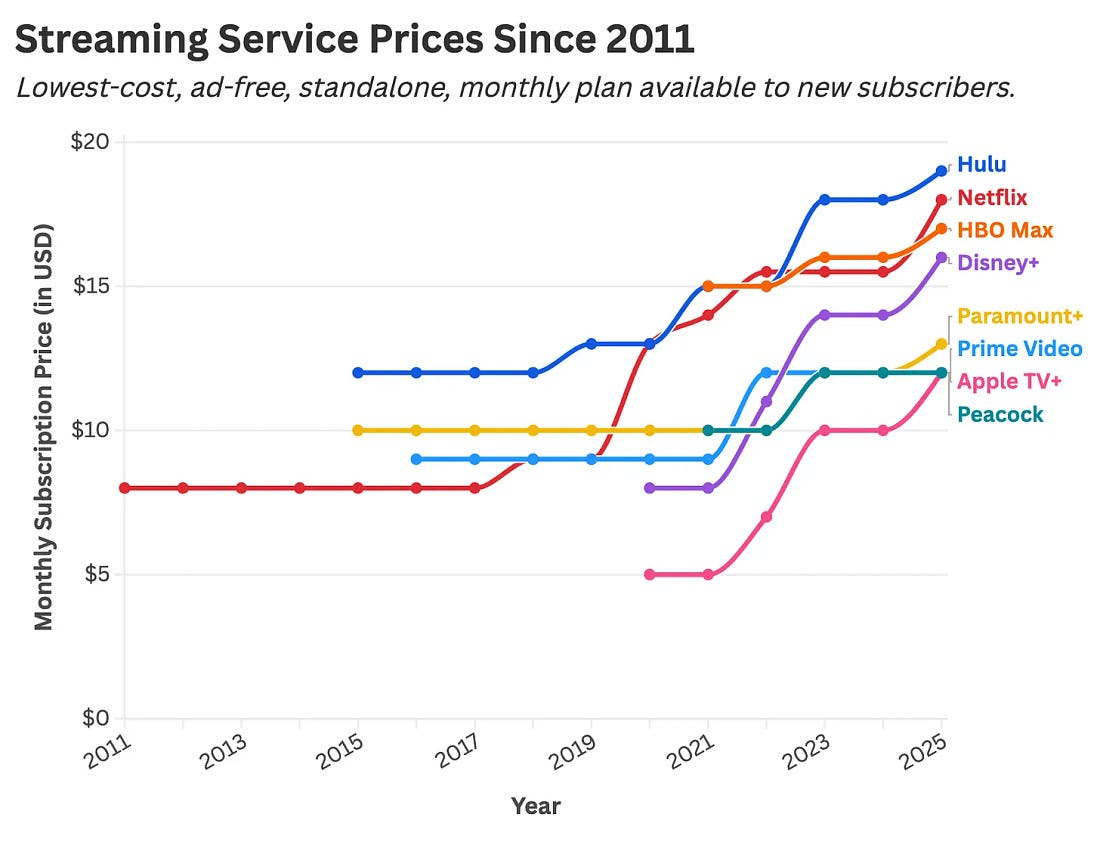
Photo of the Week
Do Not Erase

Film, music, cultural item of the Week
(via U of R)
Mark your calendar for the following events presented by the International Theatre Program:
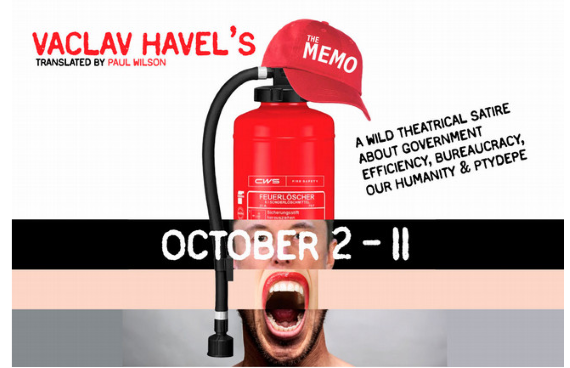
The Memo. Vaclav Havel’s classic satire The Memo, a biting, darkly comic satire of bureaucracy run amok, will run Oct. 2 through Oct. 11 at Smith Theatre in Sloan Performing Arts Center on the River Campus. Curtain times are 8 p.m. and 2 p.m. for matinees. Matinees on Oct 3 and Oct 5 will be ASL interpreted.
Ticket prices are $20 for the general public; $15 for Seniors (65 and over) and University staff, faculty, alumni; $10 in advance for University students; and $10 for non-University students. (Free tickets for University students at all mainstage/Smith Theatre shows are only available at the Sloan Performing Arts Center or Todd Theatre Box Offices 1 hour before showtime.)
Purchase tickets online or visit the Todd Theatre or SPAC Box Office. The box office opens 1 hour prior to curtain. Read more information about the production.
They Said It
“If you want a picture of the future, imagine a boot stamping on a human face—forever.”
(Big as its tent may be, liberalism is meant to prevent boots from stamping on people’s faces )
George Orwell