I had the AIs summarize these links. "This page is nominally about careers.
It is really about becoming the kind of person other people want to trust, hire, recommend, work with, learn from, and bet on.
In a world of AI, credential inflation, and hypercompetition, the scarce traits are not merely technical skills. They are judgment, intellectual tenacity, emotional steadiness, honesty, initiative, persistence, seriousness, and the ability to cooperate without becoming a conformist.
Do not just ask, “What should I put on my résumé?” Ask: Am I becoming the kind of person who can be trusted with hard things?" OK, Professor Rizzo again, maybe the way to summarize all of this is to ask yourself, "What do I do when no one is watching?"
KeyBanc Capital Markets — Banking Opportunities
Submit your résumé by 11:59 p.m. Sunday, October 4, 2026.
A University of Rochester alum at KeyBanc Capital Markets wants to see résumés from students interested in banking:
Open to all class years, from first-years through seniors. Interested in business or finance? The Greene Center collects student résumés and shares them with alumni and recruiters at partner companies so hiring decision-makers can see your experience.
Use the link above on your phone, or scan the QR code below. Sign in with your Rochester account and choose the appropriate résumé book.
FTC Bureau of Economics — Statistician Positions
GS-07 and GS-09 · Washington, D.C. · Starts as late as Summer 2027
Strong data skills? Work alongside PhD economists on antitrust and consumer protection investigations, statistical analysis, and economic research. Especially relevant for graduating seniors and master’s students with coursework in economics, statistics, data science, or computer science.
Application deadline: October 24, 2026.
One-year term, renewable up to four years. Skills sought include Stata, R, or Python; GS-09 candidates should also bring more advanced programming and data-analysis experience.
Applying for GS-09? Apply separately for GS-07 too. The FTC recommends both applications so you can still be considered at GS-07 if you do not qualify for GS-09. Résumés must be two pages or less.
Eight weeks combining a guaranteed internship, George Mason University courses, furnished housing, and career and networking events. The Public Policy & Economics track is a natural place for economics students to start; other tracks cover international affairs, journalism and communications, and business and government relations.
Early application deadline: November 5, 2026.
TFAS advertises more than 80 full scholarships and hundreds of partial awards. Program fees apply; request scholarship consideration with your admissions application.
Inside Edgeworth – The Work, the People, the Culture
Monday, October 19, 2026 · 4:00–5:00 PM EST · Virtual (Zoom) Zoom link will be provided in advance.
Registration deadline: Friday, October 16, 2026, at 12:00 PM EST.
Edgeworth Economics, a DC-area economic consulting firm, invites University of Rochester students to an inside look at economic consulting, its work, and what a career in the field can look like. This session is ideal for students completing their bachelor’s or master’s degrees between now and June 2027, particularly those studying economics, mathematics, statistics, data science, and related fields.
Students will hear directly from members of the team, learn about internship and full-time opportunities, and get recruiting guidance on what makes a strong candidate, résumé and application tips, and practical advice for interview success. There will also be giveaways throughout the session.
Edgeworth’s Founder and CEO, John H. Johnson, PhD, earned his BA in Economics at the University of Rochester.
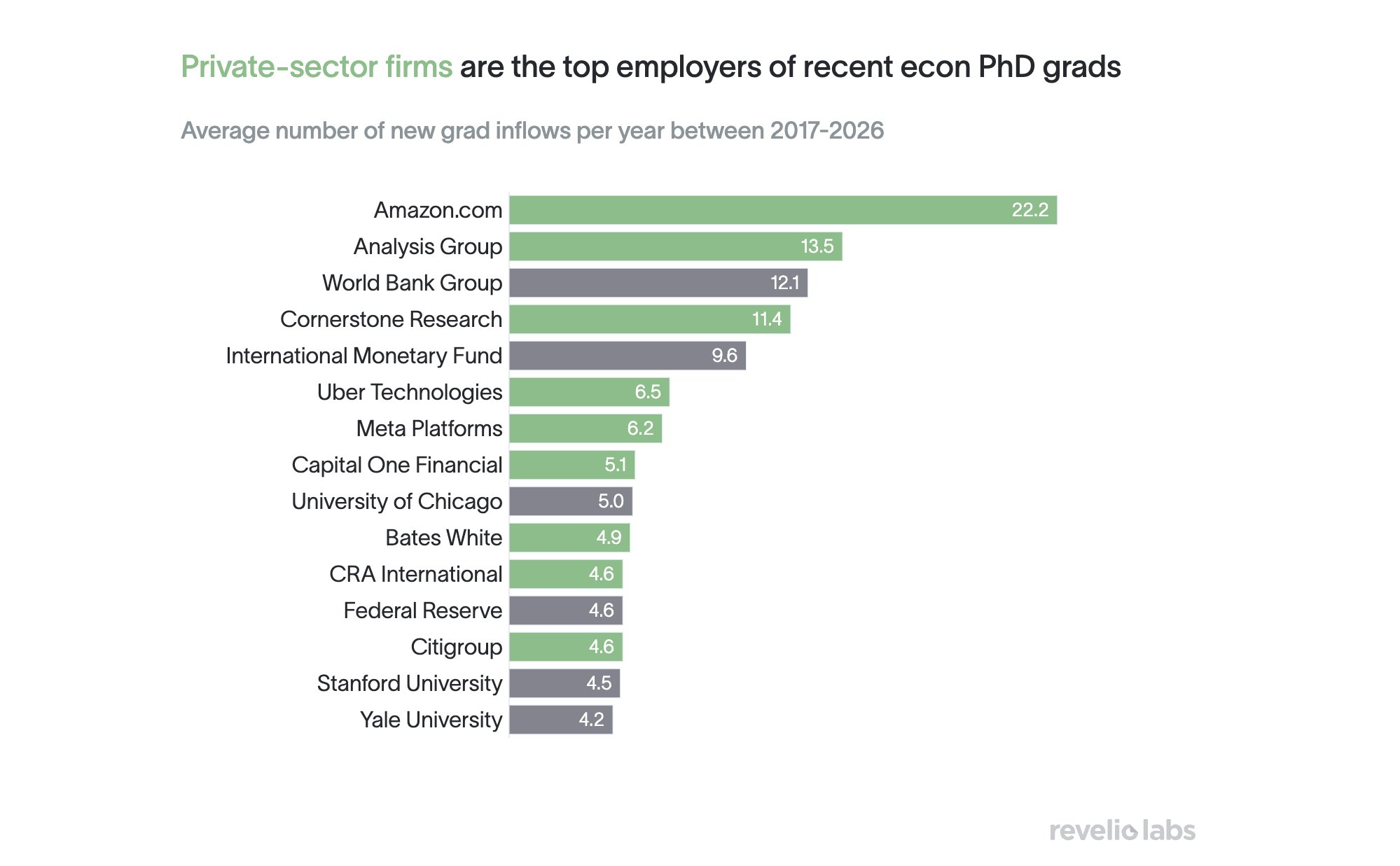
Where can an economics PhD lead? This Revelio Labs chart compares employers by their average annual intake of recent economics PhD graduates from 2017–2026. Amazon, Analysis Group, and the World Bank Group lead the employers shown, alongside consulting firms, technology companies, financial institutions, universities, and public institutions.
Chart: Revelio Labs. Covers recent economics PhD graduates, 2017–2026. Click the chart to view it at full size.
Students often want a checklist: the right major, the right internship, the right LinkedIn polish, the right campus activities, the right résumé words. Those things matter, but they are not enough.
The deeper question is whether you are developing the traits that make adults, employers, mentors, and colleagues willing to invest in you.
Core claim: The best preparation for careers, graduate school, leadership, friendship, and adult life is character plus competence. One without the other is fragile.
The links and notes below are not assigned readings. They are prompts. Pick one, read seriously, and ask what it would mean to live differently if the argument is right.
Core Principles
1. Become hard to replace.
AI will make routine symbolic work cheaper. The response is not panic. The response is to develop judgment, taste, tenacity, communication, and the ability to use tools rather than be displaced by them.
2. Stop living by checklists.
Requirements matter, but requirements are minimums. Being excellent requires initiative, persistence, curiosity, and an appetite for hard problems.
3. Learn to work with things, people, and symbols.
Many elite students are trained mostly for symbolic work: writing, calculating, analyzing, coding, modeling. The most robust careers often combine symbolic work with people, operations, institutions, technical tools, or physical reality.
4. Work where incentives teach you.
Your first jobs shape your standards. Do not work for people you do not want to become.
5. Be serious about something.
Seriousness orders priorities. If nothing is sacred, life becomes drift.
Searchable Resource Library
Showing all resources.
Character, Jobs, Success
Start Here · Character · Labor Market
A reminder that students anxious to check boxes and get requirements done often miss what employers and institutions actually value.
Occupational personality requirements can be grouped into intellectual tenacity and social adjustment. Intellectual tenacity includes achievement, effort, persistence, initiative, analytical thinking, innovation, and independence. Social adjustment includes emotion regulation, concern for others, social orientation, cooperation, and stress tolerance.
The point is not that skills do not matter. The point is that skills without tenacity, steadiness, cooperation, and judgment are less valuable than students often imagine.
If You Can’t Get a Job Today, It’s Your Fault
Start Here · Agency · Labor Market
A deliberately blunt piece about agency, labor-market excuses, and the difference between a hard market and a passive job search.
If you work on an important problem, you should work harder and aim higher. This is a useful corrective to the fantasy that success is mostly about balance, vibes, or credentials.
Advice without a link, but worth keeping: do not merely chase obvious crowded status ladders. Find neglected combinations of skills, tastes, and problems where you can become unusually valuable.
How Do Elite College Graduates Prepare for a Labor Market in a World of AI?
AI and Work · Symbolic Labor · Automation
Remember the three types of jobs: working with things, working with people, and working with symbols. College often prepares students for symbolic work, but AI is changing the economics of routine symbolic tasks.
From now on, all symbol-using jobs involve software development. Instead of writing jobs, there will be jobs developing software that writes. Instead of financial analysis jobs, there will be jobs developing software to do financial analysis.
The practical advice: adopt the software-development mindset. Whenever you catch yourself doing something repetitive, ask whether a tool, script, spreadsheet, template, or system should do it.
Adulthood is not age. It is responsibility, self-command, honesty, the ability to delay gratification, and the capacity to take care of yourself and others.
Take primary responsibility for your actions and choices.
Admit mistakes and learn from them.
Do not let emotional reasoning and snap judgment run your life.
Recognize that the world does not exist to make you happy.
Keep promises, act honestly, and value integrity.
Develop comfortable control of your own identity.
Surely You Can Be Serious
Character and Adulthood · Seriousness · Priorities
Seriousness is not a late-life reward for playing the game well. It is a basic practice that keeps life from disintegrating.
Being serious means holding something sacred. If you do not feel like you are doing that right now, take a small but perceptible step toward doing that tomorrow, and then another step after that.
A general guide to doing important work: choosing problems, developing taste, following curiosity, and understanding that great work is not merely “work hard.”
The shape of great work is not just a point labeled “work hard.”
Progress is a policy choice. The personal version: think about where your skills give you comparative advantage and where you can help build something that did not exist before.
The cool thing about starting a new institution is you can start with a clean slate: hire the very best people from day one, start a new mission, and build out a new institution.
Work in a Sociotropic Environment
Where to Work · Incentives · Organizations
Kevin Kelly’s rule is short and brutal: do not ever work for someone you do not want to become.
Work for a profit. Profit-seeking firms are generally more sociotropic: they must create value for customers, and they must develop employees who can help satisfy those customers.
The larger lesson: the organization you join will teach you. Choose carefully.
Where the CEOs of Fortune 500 Firms Went to College
Economics Degree and Fit · Status · Institutions
Arkansas, Auburn, Illinois State, and many others. The point is not that pedigree is irrelevant. The point is that pedigree is not destiny.
A crowd-sourced list of paths people have taken with economics training. Useful for students who think the only options are consulting, finance, law, or grad school.
Go Deep and Wide at the Same Time: Communicate Well
Ambition and Great Work · Depth · Breadth · Communication
Do not think of college as choosing between specialist and generalist. The world needs both. Practice both: dive deep enough to know what real discovery feels like, range widely enough to see how ideas connect, and communicate well enough to make your work useful to others.
What Intelligence Analysts Teach Us About Preparing for Careers
Critical Thinking and Judgment · Sourcing · Tenacity
The best analysts care about sourcing, critical thinking, and process. They are relentless about questions and skeptical of fluff.
The people who crush it are like a dog with a bone. They will not let go. They have a question, and they are going to answer it. The tenacious ones care about sources, critical thinking tools, and keeping score.
In an era of grade inflation and intense competition, what is most valuable? Hint: it is not something on a checklist.
No resources match that search/filter. Try a broader search term.
Valid categories currently used by the filter are: