The degree
Usually 5–6 years. The first years are coursework and exams. The later years are research, field specialization, seminars, teaching/research assistant work, and a dissertation built around original papers.
ResearchLong horizon
A guide for undergraduates considering an economics PhD, predoc work, research careers, and the professional economics job market.
← Back to Office Hours & Student Information · Economics Department Information
An economics PhD is not “more undergraduate economics.” It is a long research apprenticeship in theory, econometrics, data, institutions, and original intellectual production. It is demanding, hierarchical, and sometimes absurd. It is also one of the few graduate paths where strong students are often funded rather than charged tuition, and it can lead to academic, policy, government, nonprofit, central bank, consulting, technology, finance, and research careers.
It is a research degree. The goal is not to be a better undergraduate student. The goal is to become someone who can produce new economic knowledge.
Usually 5–6 years. The first years are coursework and exams. The later years are research, field specialization, seminars, teaching/research assistant work, and a dissertation built around original papers.
ResearchLong horizon
Competitive economics PhD programs are often funded. That usually means tuition remission plus a stipend, often in exchange for teaching or research work after the initial fellowship period.
Do not self-fund casually
Applications are not just “I like economics.” You need evidence: math, statistics/econometrics, programming, research experience, serious writing, strong letters, and proof that you can become a researcher.
Evidence beats vibes
The right question is not “am I smart enough?” It is “do I want the life and work of research enough to train seriously for it?”
Most serious economics PhD conversations should start from this premise: do not pay sticker price for a standard economics PhD unless you have a very unusual reason.
Tuition remission, a living stipend, and sometimes health insurance or health-fee support. Funding can be fellowship-based, teaching-assistant-based, research-assistant-based, or some combination.
The true cost is opportunity cost: 5–6 years of foregone full-time earnings, geographic flexibility, uncertainty, and delayed entry into other careers.
Deep research training, access to high-skill labor markets, and the possibility of academic, policy, central-bank, tech, consulting, finance, nonprofit, and government research careers.
Admissions committees are trying to predict research success. Give them evidence.
Calculus, linear algebra, probability/statistics, and ideally real analysis. Math is both tool and signal.
Take statistics and econometrics seriously. Learn causal inference, robustness, replication, and the limits of identification.
Python, R, Stata, SQL, data cleaning, Git, reproducible workflows, and comfort with messy data.
RA work, thesis/capstone, independent papers, replication projects, predoc work, or substantial faculty-supervised research.
You need economists or serious quantitative researchers who can credibly say you can do research.
Write clearly. A statement of purpose should show fields, questions, papers, data, and fit — not generic enthusiasm.
Read papers until you can tell the difference between clever, important, fashionable, and empty.
Graduate school rewards persistence, independence, and the ability to recover from rejection, confusion, and slow progress.
This is not lockstep. It is a way to avoid arriving in senior year with vague interest and no evidence.
The profession does not merely reward answers. It also shapes which questions economists learn to ask and which methods young researchers are encouraged to use.
Direct: The share of causal claims in economics papers reportedly rose from 7.7% in 1990 to 32.6% in 2023. Development, crime, and gender research expanded while econometric theory, monetary policy, and corporate governance declined proportionally. Papers containing more causal claims also receive more citations and appear more often in top-five journals.
Implied (inference): The credibility revolution has become an incentive system: journals reward designs that can be presented as causal, potentially shaping topics and methods before researchers even see the data.
Why it matters: Economics may be gaining empirical discipline while losing some theory, institutional knowledge, measurement work, and questions that do not admit a fashionable identification strategy.
Comments: The useful disagreement is not “causal inference good or bad,” but whether transparent identification makes errors easier to discover or creates false confidence through causal branding.
Where can an economics PhD lead? This Revelio Labs chart compares employers by their average annual intake of recent economics PhD graduates from 2017–2026. Amazon, Analysis Group, and the World Bank Group lead the employers shown, alongside consulting firms, technology companies, financial institutions, universities, and public institutions.
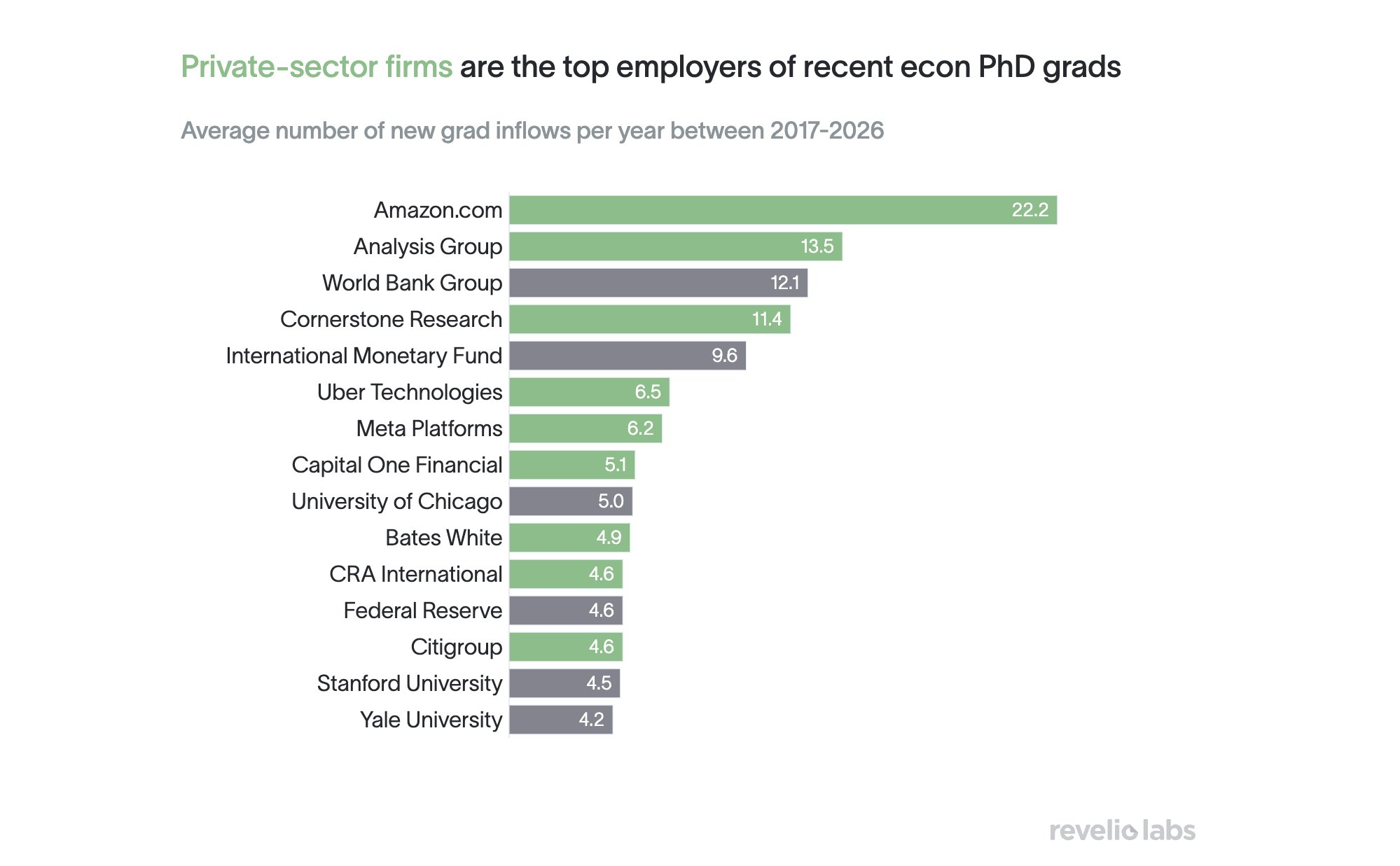
Read: “The top private sector employers of economics graduates” — Tyler Cowen, Marginal Revolution, October 1, 2026.
The market is broad, data-rich, and hierarchical. Students should understand both the opportunities and the structure before committing.

Figure shared in the material for this page: flows from PhD programs to departments by rank category. The main student lesson is not despair; it is realism. Placement is hierarchical, but not zero-sum in the way undergraduates often imagine. The PhD path includes academic, policy, central bank, research, consulting, finance, technology, and nonprofit tracks.
Search by topic: funding, math, predoc, applications, statement, job market, JOE, AEA, Marginal Revolution, letters, research, writing, forums, or careers.
Showing all resources.
The central AEA student portal for graduate-school preparation: degrees, timeline, funding, math preparation, rankings, job market, and doctoral-career pathways.
A practical planning sequence for building a list of programs, gathering letters, preparing materials, and applying on time.
The clearest official reminder that serious economics graduate preparation is also serious math preparation.
Useful overview of how graduate school is financed and where students can look for support beyond program funding.
Alphabetical list of US graduate programs in economics and related degrees. Start here when building a program list.
A broad AEA guide to where economics training leads: business, law, government, nonprofits, international relations, and academia.
Overview of research and teaching careers for economists, including academic and nonacademic research work.
The official American Economic Association job market hub for economists. Students should browse it to understand what PhD-level jobs look like.
Tracks job-market status information such as interview invitations, flyouts, offers, and closed searches.
AEA committee resources and updates on the economics PhD job market.
Professional guide to the economics PhD job market process, especially useful for understanding what students eventually face.
Central listing of predoctoral research positions. These jobs are now a major bridge from undergraduate study to competitive PhD applications.
Programs and training that help students learn about predoctoral work, coding, research skills, and doctoral-career pathways.
Frequently updated list of full-time research positions connected to NBER-affiliated researchers, often lasting 1–3 years.
A student-friendly guide to applying to economics PhD programs, including preparation, applications, and what admissions committees are looking for.
Classic advice from Susan Athey on interests, preparation, essays, letters, and how to think about economics PhD applications.
Concise notes on the key elements of an economics PhD application.
Especially useful for turning vague interests into a credible statement of purpose.
Blunt, useful answers about research experience, field choice, and whether a PhD is the right move.
Mankiw collects classic advice from senior economists on research topics, writing papers, finishing the PhD, job market preparation, publishing, and talks.
A simple explanation of why admissions committees care so much about math: theory, econometrics, reading the literature, rigor, and signaling.
Large curated page of advice links for economists: research, writing, presenting, publishing, job markets, and professional survival.
A field guide to doing economics: research, professional development, writing, presentations, and becoming a scholar.
Advice on how economists should write research papers: clarity, structure, contribution, and discipline.
A snapshot of 2013–14 job-market stars and what they were producing; useful for seeing fields, methods, and intellectual fashion.
Visual evidence on hierarchy and placement flows from PhD programs to departments. The figure is included on this page as a cautionary signal.
A notorious forum that can reveal professional anxieties and rumors, but should be used carefully and sparingly. Do not let anonymous forums shape your identity or confidence.
AEA-hosted professional discussion forum for economists.
A useful professional community/account for following empirical microeconomics, seminars, people, and opportunities.
A crowdsourced tracker for economics conferences and submission dates.
Crowdsourced tracker for economics RA and predoc opportunities.
Comic relief. Not a plan for your life, but occasionally more accurate than it should be.
A famous anthropological spoof of the economics profession. Funny because there is enough truth in it.
A skeptical view of whether the profession rewards practical insight or increasingly inward-looking technical difficulty.
Across 18 academic fields, award-winning researchers have become more widely distributed across institutions — except in economics. Economics has moved in the opposite direction and is now the most institutionally concentrated field in the study.
The authors examine nearly 6,000 award-winning researchers across the natural sciences, engineering, and social sciences, focusing on trends since the 1960s. They associate economics’ unusual pattern with stronger sorting by institutional prestige, less reliance on specialized equipment, and judgments based on a synthesis of evidence rather than decisive experiments or proofs. The paper considers both the benefits and costs of this concentration.
High and Rising Institutional Concentration of Award-Winning Economists
Richard B. Freeman, Danxia Xie, Hanzhe Zhang, and Hanzhang Zhou · NBER Working Paper 35875 · Featured October 5, 2026 · Not yet peer reviewed.
A provocative way to think about funding, opportunity cost, and whether an economics PhD can be unusually cheap relative to other graduate paths.
A proposed research path for PhD students: opinionated, contrarian, and useful for thinking about taste and agenda formation.
A warning that technical skill and professional standing do not automatically equal wisdom.
Book-length guide to the economics PhD path. Useful for students who want a full narrative rather than a checklist.
Tyler Cowen’s discussion of Hillmon’s book and the gap between undergraduate economics and graduate economics.
Cowen’s blunt emphasis on the job-market paper, letters, publications, and the outputs that define academic candidates.
Cowen/Tabarrok lesson for young scholars: protect attention and do not let low-value errands eat the time needed for reading, writing, and research.
A reminder that economists need deep reading, not only problem sets, code, and papers.
Tyler Cowen’s story of turning undergraduate work into published papers. The lesson: start earlier than you think and do real work now.
Alex Tabarrok explains the jump from learning existing knowledge to creating new knowledge in a dissertation.
A current AI-era warning: students should build complementarities with AI rather than pretend the research production function is unchanged.
Points readers to tools aggregating job-market papers, postings, and conference information.
A recent warning that the PhD economist job market has been unusually difficult, with private-sector demand as an important bright spot.
A useful, uncomfortable look at hierarchy, placement, and the mechanics of top-school job markets.
A broad reflection on how the boundaries of economics have changed and why math/computer science backgrounds matter.
Mentoring resources for students curious about economics PhD paths, especially students with less access to inside information.
A practical, student-facing survival guide for graduate school.
Short answers to the questions students usually ask too late.
No. Many economics PhDs work outside academia: central banks, government agencies, international organizations, consulting, finance, technology firms, policy institutes, and nonprofits. But the training is still research training, so you need to want the research work itself.
Not always, but predocs have become increasingly important for competitive applicants, especially students who need more research experience, stronger letters, coding/data credentials, or clearer fields of interest.
At minimum: calculus, linear algebra, probability/statistics, and econometrics. Stronger applicants often add real analysis, optimization, differential equations, mathematical statistics, or proof-based math. The exact portfolio depends on target programs and fields.
Late is not fatal. But it changes the path. You may need a predoc, additional math, RA work, a master’s program, or a delayed application cycle. The right answer is usually to build evidence rather than rush weak applications.
Sometimes, but not automatically. A master’s can help if it gives you math, econometrics, research, letters, and a credible transcript signal. It is not valuable merely because it is another credential.
A strong letter says, with evidence, that you can do research. The best letters usually come from faculty who have seen your independent analytical work, RA work, thesis work, coding/data work, or graduate-level performance.
Browse NBER working papers, AEA journals, job-market papers, JOE fields, faculty websites, seminar schedules, EconTrack, and field-specific communities. Look for questions, data, models, identification strategies, and writing style.
Maybe once, carefully, to understand that the profession has status anxieties and gossip like every profession. Do not live there. Anonymous forums can badly distort how students understand the field and themselves.