Self-interest is not selfishness
An analytical model becomes a moral commandment, and a fabricated commandment becomes an indictment of markets.
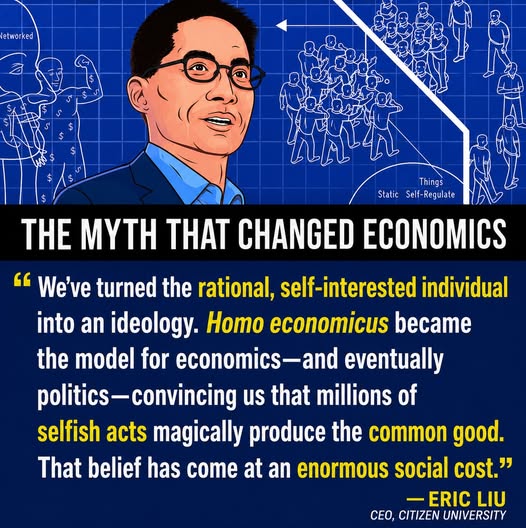
The exhibit
The accusation
Eric Liu and Nick Hanauer argue that “market fundamentalism and libertarian politics” promote reflexive selfishness. Their larger essay claims that orthodox economics turned the rational, self-interested individual into a cultural and political ideology.
Read the original article →- Authors
- Eric Liu and Nick Hanauer
- Publication
- Evonomics
- Date
- March 20, 2016
Verdict
This is a caricature disguised as intellectual history.
The authors have not refuted the market-liberal position. They have declined to describe it. They transform a simplifying model into a moral instruction, attribute that instruction to market advocates, and then condemn those advocates for believing it.
The central inversion
The essay says conventional wisdom confuses self-interest with selfishness. Yet its own indictment depends upon making exactly that substitution.
In economics, self-interest does not mean that money is the only thing people value, that generosity is irrational, or that people ought to disregard others. It means that people act in pursuit of ends as they understand them. Those ends may include family, friendship, faith, reputation, justice, charity, duty, art, community, or the welfare of complete strangers.
A parent caring for a child, a donor funding a hospital, and an entrepreneur trying to earn a profit can all be purposeful actors. The analytical category does not erase the moral differences among their purposes.
The model-to-morality fallacy
Homo economicus is an abstraction used to isolate features of choice. One may criticize the model’s predictive power, informational assumptions, treatment of preferences, or domain of application. Economists have done so for generations.
But a descriptive simplification does not become a commandment merely because it appears in a model. The assumption that an actor chooses consistently is not the moral instruction: be selfish.
The argument therefore slides across three different propositions:
- People often pursue objectives they regard as their own.
- Under specified institutional conditions, decentralized choices can generate coordination and mutual gains.
- People ought to be selfish in every transaction.
The first is a proposition about behavior. The second is an institutional claim with conditions. The third is a moral doctrine. Neither of the first two implies the third.
The invisible hand is not magic
The market argument is not that every selfish act automatically produces the common good. Fraud, theft, pollution, monopoly, violence, and rent-seeking do not become beneficial because the perpetrator wanted something.
The argument is that private property, prices, competition, contract, liability, reputation, and the rule of law can channel dispersed knowledge and conflicting purposes into peaceful cooperation. Whether they succeed depends upon the rules and circumstances. That is why economics contains entire literatures on externalities, public goods, transaction costs, information problems, market power, and institutional design.
Calling this “magic” avoids the actual work: identifying the mechanism, its domain, and the relevant alternative.
The Smith who was actually there
Adam Smith did not imagine human beings as solitary calculators without fellow-feeling. The Theory of Moral Sentiments begins from sympathy and develops an account of propriety, justice, beneficence, self-command, and the impartial spectator.
Smith’s distinction between justice and beneficence matters. Justice can properly be enforced because injury violates another person’s rights. Beneficence is admirable precisely because it is freely given. A liberal order protects the space in which people can practice generosity, friendship, loyalty, sacrifice, and love without converting every virtue into a legal command.
The Evonomics essay eventually invokes The Theory of Moral Sentiments as a neglected corrective. But that does not establish its accusation that market advocates or libertarians prescribe reflexive selfishness. It acknowledges the moral tradition that the accusation has written out of the opposing position.
Original sources
TMS Adam Smith, The Theory of Moral Sentiments WON Adam Smith, The Wealth of Nations ESSAY Lauren Hall, “Self Interest Rightly Understood”The real capitalist response
Markets are not rituals for sanctifying greed. They are institutions that permit people with different knowledge, purposes, loyalties, and moral commitments to cooperate without requiring a single authority to choose their ends.
Private property does not tell an owner what to love. It establishes who may decide—and who bears responsibility—within a defined sphere. Individual liberty does not prohibit altruism. It protects a person’s right to be as generous, communal, religious, eccentric, or commercially ambitious as that person chooses, provided the equal rights of others are respected.
A real capitalist also distinguishes markets from whatever powerful firms happen to want. Subsidies, bailouts, occupational restrictions, protection from competition, and regulatory privileges are not vindications of free enterprise. They are attempts to replace market tests with political power.
The serious argument they could have made
There is a legitimate and important question buried beneath the caricature: institutions may shape character as well as coordinate behavior.
A serious critic could ask whether some market arrangements crowd out intrinsic motivation, weaken social norms, reward short-term conduct, or fail to make actors bear costs imposed on others. Those propositions can be defined, investigated, and compared with the effects of political and communal alternatives.
That would be an argument about institutional conditions and evidence. It would not require inventing a libertarian commandment of reflexive selfishness.
The five-question test
| Test | Result |
|---|---|
| Are the central terms defined? | No. “Market fundamentalism” and “libertarian politics” perform accusatory work without identifying a doctrine or representative defender. |
| Is a causal mechanism supplied? | No. A sweeping intellectual genealogy substitutes for evidence that an economic model created a culture of selfishness. |
| Is the counterfactual identified? | No. “Mutual interest” is presented as a discovery rather than a feature markets can—and often do—serve through exchange and cooperation. |
| Are real institutions compared? | No. Flawed market outcomes are not compared with political incentives, information limits, coercion, capture, or implementation failure. |
| Are opponents represented from original sources? | No. The essay invokes Smith but does not establish that representative market liberals teach the creed it condemns. |
Ruling
The essay’s humane concern for cooperation is not the problem. Its counterfeit account of the market-liberal position is. Compassion does not excuse an argument from definitions, mechanisms, evidence, or intellectual history.