The invisible hand is not a promise
Labor conflict does not refute spontaneous order—and political privilege does not become capitalism merely because capitalists obtain it.
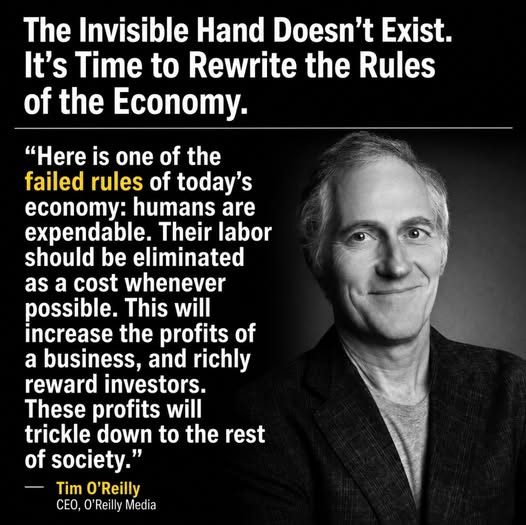
The exhibit
The accusation
Evonomics introduces Tim O’Reilly’s argument by claiming that the well-paying jobs remembered with nostalgia “weren’t created by the invisible hand” but were won through labor organizing and strikes. The accompanying graphic declares: “The Invisible Hand Doesn’t Exist.”
Read the original article →- Author
- Tim O’Reilly
- Publication
- Evonomics
- Date
- August 4, 2016
Verdict
The argument confuses three different things: spontaneous order, prosperity, and political power.
The invisible hand never promised ideal outcomes without bargaining, conflict, organization, law, or institutional change. Nor did unions summon modern working conditions into existence by political will. Labor conditions, productivity, wealth, worker choice, technology, firms, unions, and law coevolved. The decisive market-liberal question is not whether capital or labor wrote a rule. It is whether people remain free to associate, refuse, enter, exit, and compete—or whether an organized interest has acquired power to impose terms on unwilling others.
The first error: refuting a promise nobody made
The invisible hand is not a deity guaranteeing perfect wages, perfect safety, or perfect justice. It is a metaphor for patterns of coordination that emerge from human interaction without any participant designing the whole.
People possess different fragments of knowledge. They pursue different purposes. Prices, firms, customs, occupations, technologies, unions, laws, and political coalitions develop as people respond to one another. Some resulting orders coordinate remarkably well. Others preserve mistakes, privileges, bottlenecks, or injustices.
Spontaneous does not mean perfect. Emergent does not mean just. Unplanned does not mean immune from criticism.
The existence of bargaining and strikes therefore does not refute spontaneous order. Bargaining and strikes are among the decentralized actions through which the order changes.
The article contradicts the poster
The promotional graphic announces that the invisible hand does not exist. The article itself later describes the invisible hand as “the push and pull of the many players in the game” and says that it will do its work—through struggle.
That is not a refutation. It is a serviceable description of the idea the headline pretends to destroy.
If the invisible hand refers to decentralized adjustment among people pursuing competing purposes, then firms, workers, consumers, unions, courts, legislatures, and voters all participate in the process. The fact that the process contains conflict establishes neither that it is centrally designed nor that one faction “created” the final outcome.
Good working conditions coevolved with wealth
The claim that unions gave us the five-day week, safe workplaces, high wages, and humane employment reverses causality and awards one institution credit for a transformation it could not have produced alone.
Labor conditions coevolve with:
- worker productivity and accumulated capital;
- technology and the substitution of machines for dangerous labor;
- worker savings, mobility, education, and alternative employers;
- firm profitability and the cost of retaining good workers;
- consumer wealth and willingness to pay for better production conditions;
- unions, professional associations, social norms, insurance, tort law, and legislation;
- the administrative capacity to define and enforce increasingly demanding standards.
Workers in poor societies commonly endure worse conditions than workers in rich societies. The central difference is not that poor workers have failed to discover activism. Poverty constrains the feasible choices of workers and employers alike. A worker with no savings and few alternatives cannot easily reject exhausting or dangerous work. A low-productivity firm operating close to subsistence margins cannot sustainably provide the compensation, leisure, equipment, insurance, and protection common in wealthy economies.
As productivity and living standards rise, workers acquire better alternatives and become less willing to accept danger, abuse, and exhausting hours. Firms can afford better conditions, face greater costs when skilled workers leave, and adopt capital that makes work safer and more productive. Workers can finance organizations, strikes, political campaigns, and time without wages. Governments acquire both the resources and public support to enforce more demanding rules.
Unions may accelerate, articulate, negotiate, or codify parts of that process. They may help incumbent workers capture a larger share of rising productivity. But they do not create the underlying abundance that makes improved conditions sustainable.
Unions did not simply “give us” the five-day week
Organized labor advocated shorter hours, but the five-day week did not descend upon a poor economy because unions demanded it.
During the 1920s, firms experimented with shorter schedules as productivity rose, labor markets changed, and managers reconsidered the relationship among hours, output, retention, and consumption. By 1927, hundreds of large establishments had adopted the five-day week. Henry Ford’s famously nonunion operation accounted for more than half of American workers then reported to have five-day schedules.
Later legislation helped standardize the forty-hour week, and unions helped negotiate shorter hours in particular industries. But legislation and collective bargaining occurred inside a society wealthy and productive enough to make forgone work time affordable.
The honest history is coevolution: productivity made shorter hours increasingly feasible; rising worker alternatives made them increasingly necessary; firms and unions bargained over the gains; social expectations changed; and law later codified parts of the developing settlement.
Examine the historical development of working hours →
The second error: treating an organized interest as “the workers”
A union is not identical with labor. It is an institution with officers, employees, budgets, political alliances, incumbent members, and an interest in its own survival.
Its objectives may diverge from those of:
- workers excluded from the bargaining unit;
- unemployed workers seeking entry;
- younger workers disadvantaged by seniority rules;
- workers who prefer individual negotiation or a different representative;
- consumers paying higher prices;
- taxpayers financing public-sector agreements;
- workers in competing firms, industries, or jurisdictions;
- future workers affected by reduced investment, entry barriers, or automation.
A union may improve compensation for members while reducing employment, restricting entry, preserving obsolete work rules, resisting productivity improvements, or transferring costs to outsiders. Whether it does so is an empirical and institutional question. Invoking “the workers” does not answer it.
Voluntary unions and legally privileged unions are not the same
Workers voluntarily pooling resources, withholding their labor, selecting representatives, and bargaining collectively are exercising freedom of association. A genuinely voluntary union deserves the same liberal protection as any other peaceful association.
American labor law, however, goes beyond protecting voluntary organization.
Although the Sherman Antitrust Act did not explicitly outlaw labor unions, federal courts used antitrust law and injunctions against union activities by treating combinations of workers and some strikes or boycotts as restraints of trade. Congress then created special labor protections through the Clayton Act, the Norris–LaGuardia Act, the Wagner Act, and subsequent legislation.
The resulting system contains exclusive representation. A union receiving a majority of the votes actually cast in a certification election becomes the bargaining representative for the entire unit—including workers who voted against it, did not vote, arrived later, or would prefer individual negotiation. Low turnout therefore can allow a union supported by a minority of all eligible workers to obtain authority over everyone’s terms of bargaining.
Those workers are not legally required to become full union members. But they are required to accept the certified union as their exclusive bargaining representative. In private-sector workplaces in states without right-to-work laws, a union-security agreement may also require nonmembers to pay permitted representation-related fees as a condition of employment. Public-sector agency fees are now prohibited without affirmative consent under Janus v. AFSCME.
These distinctions matter. Calling the entire arrangement “voluntary association” conceals the very coercion a liberal analysis must examine.
Law and original sources
1776 Adam Smith, The Wealth of Nations 1945 F. A. Hayek, “The Use of Knowledge in Society” LAW National Labor Relations Board, National Labor Relations Act PROCESS U.S. Department of Labor, union certification and exclusive representation 2018 U.S. Supreme Court, Janus v. AFSCMEThe institutional corruption O’Reilly nearly sees
O’Reilly is correct that economic outcomes depend partly on rules—and that organized interests struggle to shape them. But this does not vindicate whichever group successfully captures the rule-making process. It creates a reason to distrust concentrated political power.
Capitalists can corrupt capitalism. A corporation that obtains tariffs, subsidies, licensing restrictions, bailouts, regulatory barriers, favorable tax provisions, or legal protection from competitors is not demonstrating the virtues of markets. It is escaping market discipline through political power.
The same standard applies to unions. A union that obtains compulsory representation, financial support from dissenters, restrictions on competing workers, political appointments, or rules written for the organization’s benefit is not merely exercising freedom of association. It is using government to impose terms on people who did not consent.
Many attacks on “capitalism” therefore identify genuine abuses but name the wrong institution. They describe capitalists using the state to restrict competition and then attribute the resulting privilege to free exchange. The culprit is not too much voluntary association. It is the displacement of voluntary association by political privilege.
The real capitalist response
A real capitalist does not defend everything done by a business owner. Nor does he condemn collective action merely because workers undertake it.
He defends private property, voluntary exchange, freedom of association, freedom not to associate, open entry, competition, and responsibility for costs.
That means:
- workers may organize voluntarily;
- employers may resist or accept their demands;
- workers may join, leave, support, oppose, or compete with an organization;
- firms may organize, merge, negotiate, and advocate;
- neither firms nor unions should acquire political privileges that compel participation, suppress competitors, externalize costs, or dictate terms to unwilling third parties.
Capitalism is not “whatever capitalists persuade a legislature to enact.” A tariff written by manufacturers, a licensing rule written by incumbents, or a subsidy written by an industry lobby is political capitalism: an effort to escape competition.
Likewise, freedom of association is not “whatever certified unions persuade a legislature to enact.” Exclusive representation, compulsory fees, restrictions on alternative bargaining, and political favoritism require independent justification because they replace individual choice with legally enforced collective authority.
The serious argument O’Reilly could have made
A serious case would ask how productivity, capital deepening, worker alternatives, union bargaining, labor law, technological change, political privilege, and postwar conditions jointly shaped particular jobs.
It would ask:
- Which improvements preceded unionization or legislation?
- Which changes became feasible only after productivity increased?
- Which union gains transferred income from firms, consumers, taxpayers, excluded workers, or future investment?
- Which protections corrected genuine contracting or information problems?
- Which rules protected incumbent unions or firms from competition?
- Could workers choose another representative, negotiate individually, or refuse financial support?
- What happened to workers who never obtained the protected jobs?
Those are questions about mechanisms and institutions. “Unions won good jobs from the invisible hand” is factional mythology.
The five-question test
| Test | Result |
|---|---|
| Are the central terms defined? | No. The graphic denies the invisible hand; the article later defines it as the push and pull of many players. “The rules” shift between market institutions, legislation, bargaining outcomes, and corporate practices. |
| Is a causal mechanism supplied? | No. Union struggle receives causal credit while productivity, capital, worker alternatives, technology, profitability, labor scarcity, and the wealth gradient in working conditions remain largely invisible. |
| Is the counterfactual identified? | No. We are not shown wages, employment, entry, prices, investment, or safety under alternative labor institutions. |
| Are real institutions compared? | No. Voluntary worker organization is conflated with exclusive representation and politically privileged unionism; market competition is conflated with capitalists seeking state protection. |
| Are outsiders and political incentives counted? | No. Incumbent union members and firms occupy the stage; dissenting workers, excluded entrants, consumers, taxpayers, and future workers do not. |
Ruling
Labor struggle can shape how gains are divided. It did not independently create the productivity and wealth that made modern working conditions possible. Nor does rule-writing become benign when unions rather than corporations capture the pen. The relevant divide is not capital against labor. It is voluntary cooperation against political privilege, open competition against imposed exclusion, and association against compulsion.